Showing posts with label wizards. Show all posts

Wednesday, October 24, 2018

Octane (2003), by Marcus Adams


Those goshdarn hifalutin' whippersnapper young people! Back in my day we didn't disrespect or disobey our parents, no sir. Almost a relief when these young folks get kidnapped by random highway-dwelling Satanic cults, dontchaknow?

You can support the site on Patreon at www.patreon.com/AdamMudman and like us on Facebook at www.facebook.com/MudmansAList.

Tuesday, July 17, 2018

Rabid Grannies (1988), by Emmanuel Kervyn


A comedy of manners set in a gloomy old house, full of black magic and blood. RABID GRANNIES!

You can support the site on Patreon at www.patreon.com/AdamMudman or like us on Facebook at www.facebook.com/MudmansAList.


Wednesday, March 21, 2018

Book Club of Desolation #23: Powers of Darkness (1900-1901), by Valdimar Asmundsson and Bram Stoker (?)


In 2014, Icelandic scholar Hans Corneel de Roos was looking over a manuscript from the turn of the 20th Century that at first seemed to merely be an Icelandic translation of Bram Stoker's Dracula, penned by writer Valdimar Asmundsson. However, he started to notice that the manuscript, entitled Makt Myrkranna or Powers of Darkness, made some substantial deviations from Stoker's original text, and it didn't take long to realize that the book was something new entirely, although it was based on Dracula. The resultant text was made available in English with notes by both de Roos and Bram Stoker's great-grandnephew Dacre Stoker. Makt Myrkranna is simultaneously an awesome part of horror fiction history, a superior novel to Stoker's tale, and a suggestion of a possibility I've thought about for a long time: what if there are more books like this one, which serve as alternate versions of more famous works?

The story of Powers of Darkness roughly follows that of Dracula, but it bears repeating for the sake of this review. Jonathan--or excuse me, Thomas Harker is an English real estate agent called out to Transylvania by a mysterious noble named Count Dracula, who is interested in buying property in London. Harker is warned by everyone he encounters along the way that Dracula is pure evil, but he must carry on with his job. You see, Harker is kind of an idiot--even moreso than in Stoker's novel. Dracula is an amiable enough fellow but his castle looks like no one's lived in it properly for centuries. He also gets a hungry look in his eye when he sees Harker cut himself. Pretty standard Stoker stuff so far, but Stoker never mentioned Dracula's triumphant pride in the incestuous of his family, which produces short-lived, stumpy freaks. Nor did he mention Dracula's underground chamber where he and his gorilla-man army sacrifice villagers to Satan. Nor did he mention that Dracula and said gorilla-man army are in league with a conspiracy of noblemen who want to destroy the democratic processes of England to create a world where the serfs serve the nobles again! (I guess Dracula never heard of Wall Street, then.) Will Harker be able to escape Dracula's horrifying fortress to warn his beloved Wilma, or will he be food for Dracula's vampire brides?

"But wait!" you ask. "What about Holmwood and Quincy Morris and Lucy and van Helsing? What about, y'know, the other three-quarters of the novel?" Well, that's the thing about Powers of Darkness: most of the book is Harker trying to survive his weeks in Dracula's castle. There is a second part which features most of the same events as Dracula--the arrival of van Helsing, the vampirism and staking of Lucy/Lucia, the menace hanging over Mina/Wilma, and finally the battle against Dracula and his servants in the shadow of the vampire's castle. Where the end changes is that Dracula's castle crumbles upon his death, and then the nobles who allied themselves with him commit suicide or are murdered, ending his conspiracy. As the introduction and notes posit, this part was likely meant as an outline for what Asmundsson would write later, suggesting that Powers of Darkness in its complete form (assuming that we have today isn't the complete form) would have dwarfed Dracula in length and complexity. As it stands already, Asmundsson's text succeeds at being far scarier than Dracula, perhaps because of its choice to frontload.

Asmundsson understood the Harker parts had the best potential for horror. Dracula's wild, rambling structure gives it the feeling more of an adventure novel than a Gothic piece, which is awkward because it's told, as Powers of Darkness is, through letters and diary entries. It's weird to hear the tale of a frantic carriage chase recounted post-facto in a journal. But the bulk of Powers of Darkness reads like something someone found in Dracula's castle next to Thomas Harker's emaciated corpse--you never know which entry is going to be the last. This is broken only somewhat by the fact that, again, Harker is a massive idiot, as he pointedly does not try to leave the castle until it's nearly too late, even after witnessing Satanic rituals in progress! He is remarkably tolerant of many horrifying supernatural incidents. Sometimes, though, justifying logic breaks through. After all, it's probably more than Harker feels he can't leave the castle, as it's on a high rocky pass in the middle of nowhere, surrounded by wolves and God knows what else. There's also the fact that he came here to do a job, and at least at the beginning, much of his response to the ghoulish things he encountered is a very natural sort of confusion--perhaps he's imagining things, or maybe this is some local custom he as a privileged Londoner doesn't understand. Even if he trusts his instincts when he is sure the supernatural is afoot, he can't exactly return to his boss in England emptyhanded and tell him, "Sorry, the client was a Satanic vampire with a gorilla-man army which he was gonna use to tear down the government, no sale."

Now, this book would not be complete without the introduction and notes it provides. Dacre Stoker's introduction was interesting in its argument that Makt Myrkranna was based on Bram Stoker's private notes, and that Stoker and Asmundsson collaborated in the latter's penning of Powers. He brings up the fact that it was popular for Victorian authors to travel to Iceland, as they admired Iceland's astonishing poetic tradition; he also points out that several details from Powers match with unused story bits from Stoker's notes, such as the "hidden red room" where Dracula performs his evil magic, and the blind-mute woman who serves the vampire. However, I would caution against assuming that works such as these are made with the collaboration of the original author, because certain tropes are universal, and there are such things as coincidences. Respect the fanfic, I guess is what I'm saying. On my first read-through of the introduction I was disappointed that Dacre Stoker generally abstained from praising Asmundsson's individual creativity in the parts of Powers that weren't seemingly based on his great-granduncle's work, but a closer look-through on my part shows the integrity of his investigation. Similarly, I found de Roos' footnotes to be cluttery and intrusive at times, but they form a log of the challenges he ran into in translating early 20th Century Icelandic into English. When I studied linguistics I found the bond between Icelandic and English one of the most fascinating my professors discussed: modern Icelandic and Old English are extremely similar. In fact one of my professors told me that if an Anglo-Saxon time-traveler from pre-Norman England landed in today's Iceland they'd probably be able to have a reasonable conversation with someone there.

Overall, this new edition of Makt Myrkranna is an awesome look at vampire fiction history, and one of what I hope will be many discoveries of other pseudo-classics cloned from books that history remembered better. And, similarly, it's better than the original Dracula. Horror fans can't afford to miss out.

Books are pricey, but you can help sponsor the Book Club of Desolation on Patreon! Plus, you can like the A-List on Facebook to get updates.

---

Image Source: Amazon

Monday, August 21, 2017

The Ghost of Rashmon Hall (1947), by Denis Kavanagh


Frankly, if I like this, I'm an idiot. Some permutation of that supposition comes up basically every third review at this point, but c'mon. They couldn't even get the name of the house right in the title. Let's just get out of the way, because all the other reviews of this movie (all three of them) all make light of this: the house in the movie is called Rammelsham Hall, not Rashmon Hall. Yes, yes, that's a problem with the U.S. distribution title and the movie is really called Night Comes Too Soon; but this is proof nonetheless that The Ghost of Rashmon Hall starts with idiocy, and ends with idiocy. This is a movie where I like it not for its entertainment value, but for what it makes as a summary statement. I.e. I don't like it as a movie, I like it as the idea of a movie. This is a theme which will repeat in Wednesday's review, too, which is a movie which I only enjoy for the first few minutes! But sometimes, you have to let yourself miss the forests for the trees. Let's find out why exactly Rashmon Hall is a mess even outside of its title.

The plot is extremely basic. A group of friends have met up at old Rammelsham Hall and are waiting on the last of their group, Dr. Clinton. When he finally arrives, they begin talking about ghost stories, and Clinton informs them that the very house they are presently sitting in is haunted. He begins to tell the tale of his young friends John and Phyllis, whose story we will follow for the rest of the film, save for occasional interruptions from Dr. Clinton. The young couple are looking for a new home to move into after being married, but there's a significant scarcity of available houses. The world's most poorly-acted real estate agent lets them know that he does have one other property for sale, but he seems very hesitant to send it off. It could have something to do with the fact that the cornerstone of the house not only gives the name of the house's builder and first inhabitant, Rinaldo Sabata (presumably a relative of the Western gunfighter), but it states that the occupation of that same man was "Necromancer"! As Clinton's narration says: "A necromancer is one who draws power from evil"--or, y'know, the dead, but semantics schmemantics. Anyway, the two begin to notice strange phenomenon in the house. Mysterious shadows, auto-kinetic doors, unexplained noises--the usual. It gets so bad that eventually John calls in Dr. Clinton, who helps him learn the house's secret. Rinaldo Sabata's wife took on a sailor as a lover, and Sabata killed them both and chained their ghosts and his own to the house. By destroying a compass (?) the curse is lifted and the spirits can move on. Back in the present, Clinton's guests refuse to believe the tale, until Clinton reveals that he himself is a ghost--

Hang on.

So let me get this straight. A man who has known almost every character in the film for years has been dead this whole time?! How does that make any sort of sense? As far as I remember, John and/or Phyllis were once Clinton's students...was he a ghost back then, too? The only way I feel this can work is if Clinton died on his way to the party at Rammelsham, but there's nothing to imply that in the script except for the fact that he shows up late. And even then, that's such a glancing detail that there was no way for an audience, starved of the ability to rewind and replay things, to pick that up in 1947. Maybe this is supposed to be like a comedy, where the last scene is "non-canon"; it's just meant to be a last "note" before the movie ends. But I can't buy into that because that's lazy filmmaking. Of course, it's not like this film isn't lazy to begin with.

In my Phantom of the Convent review, I briefly touched on the particular brand of mildness found in British horror films from the '30s and '40s. I also talked about how Mexican movies tend to draw on the mythology of Mexico's European heritage in a way that American movies tended to avoid. Ultimately, I feel the same principle applies to many European movies, even beyond the 1940s. Many of them adapt an Old World story with comparatively few embellishments. Consider, for example, the filmography of Britain's foremost horror star, Tod Slaughter. His most famous role is from the 1936 Sweeney Todd adaptation; while his other big roles in movies like Maria Marten and Crimes in the Dark House are based off of lurid true events of the 19th Century or else mid-Victorian literature. Presumably this was to facilitate audience familiarity with the material so they weren't baffled by things like vampire ghost dogs. In British movies, too, there's a sense of theatricality, audience participation, and general "merriment"; the fact that Tod Slaughter's movies are usually described as melodramas rather than horror films, despite their horror elements, is a testament to a difference in how Brits prefer or preferred their ghost stories. One has to remember that until comparatively recently, telling ghost stories was a tradition of Christmas--consider of course the famous Dickens novel, but also the reference to "scary ghost stories" in "The Most Wonderful Time of the Year." Horror to the Brits was a sign of comfort, perhaps because of its ability to bring people closer together. And thus is Ghost of Rashmon Hall a deliberately straightforward creaky old horror story, with, again, few embellishments beyond basic ghost tropes. It even bills itself as "a plain down-to-Earth" ghost story, such as that written by "Lord Lytton," alias Edward "Dark and stormy night" Bulwer-Lytton. Indeed, this movie is ostensibly adapted from Bulwer-Lytton's "The Haunters and the Haunted," with the point of the haunting stemming from an object which must be destroyed to lay the ghosts to rest being one of the story's few points left intact by the movie. Much else is changed: the circumstances of who the ghosts are is different, and the main characters in the film are a married couple instead of the short story's solitary narrator. And of course there are no flashbacks to one of the characters telling the story in the house's parlor in Bulwer-Lytton's piece. But indeed, both tales are very plain ghost stories, such as those which British melodrama audiences would enjoy. At least until the ending, in the film's case.

I was fascinated by how this movie reminded me of other movies. The basic premise, of course, is a prototype for The Amityville Horror, which serves to remind me how truly lazy the Amityville story was. However, its use and overuse of shadow, plus some legitimately spooky imagery--and the fact that I liked it--reminded me of Ghosts of Hanley House. I feel the two would make a pretty solid double-feature. But weirdly, one movie which it reminded me of in particular is Byron Quisenberry's The Outing, which I'll review at some point. That's another movie which is almost needlessly slow, that refuses to innovate or stand out no matter what. Yet, it manages to generate genuine creepiness, and is unexplained in a way that leaves you wanting to rewatch it. In particular, the final shot, where we pan slowly to a wine glass just before it shatters under an invisible force, reminds me of the weird final shot of The Outing where we slowly pan over to the painting which may or may not reveal who the killer is. I plan on rewatching Ghost of Rashmon Hall a few more times to see if there's anything I missed. I strongly doubt it, but we'll see.

Unfortunately, the key to that bizarro ending may be lost forever. Supposedly the film originally ran 57 minutes, but it was cut down to 49 minutes for American release, and the original British version was subsequently lost. Lost films will always bug me, no matter how insignificant they are. The Ghost of Rashmon Hall is as insignificant as it gets, but I fully believe those eight minutes probably had something good on them.

If you enjoyed this review and would like to see more like it, please consider becoming a Patron on Patreon! And don't forget to like the A-List on Facebook!

Sunday, July 23, 2017

New Book Out!! DEUS MEGA THERION & THE DIVINE MRS. E ARE HERE!!!

I have some exciting news! My double-sided party in paperback has been published by Odd Tales Productions! Check it out here on Lulu!


Publisher's Description: "DEUS MEGA THERION tells the tale of Jagged Skull, an '80s heavy metal band who runs afoul of a Satanic cult presided over by the sinister Edward Tamaron. Forced to play a string of concerts for the cult, the band members learn more about themselves and the world they live in. 

THE DIVINE MRS. E (Or, the Adventure of the Textual Lacuna) is the story of an actress who must solve a murder on the set of one of her films. But she is not who she seems to be, and her adventure will bring her face-to-face with fiction, femininity, and the divinity of both. 

This paperback features two excellent covers from James Bezecny, and has awesome flipbook action, meaning it can be read no matter what side is up. An Odd Tales Productions exclusive!"

An ebook version and a video trailer will be coming soon! And thank you!!

P.S. There will an extra review this week as Wednesday sees the release of James Bryan's long-lost soon-to-be-classic Jungle Trap. GET PUMPED!

Friday, June 23, 2017

Skullduggery (1983), by Ota Richter


We open in Canterbury--where else?--in the year 1382. Lord Adam is betrayed by his vizier, the leader of a Satanic cult, who murders the Lord for reneging on his deal to give him his soul. In addition to kill Adam he also curses his bloodline. Flash forward six hundred years to "Trottelville, U.S.A.", where Adam's descendant, also named Adam, is a costume shop employee who plays a Dungeons and Dragons clone which is unfortunately never named. After experiencing some strange incidents, like a red light appearing in the game board castle, and a harlequin puppet falling off the wall for no reason, Adam becomes possessed by an urge to carry out murders that mirror his friends' game session. Slowly, with a wide variety of sometimes-relevant tangents along the way, we seem to accomplish these murders until the rather bizarre ending where he may or may not be killed.

I've been an extremely casual D&D player since high school, and so the "D&Dsploitation" films are old friends of mine. I haven't seen all of them, unfortunately, but both Mazes and Monsters and Skullduggery have been films I've returned to over and over again over the years. I know a lot of people think it's weird that people used to demonize D&D so much, but really, I'm sure we could all make lists of the developments within our lifetimes that have had overly elaborate crusades pushed against them. The first rule of humans is that we hate that which is new, no matter its benefit to us, and no matter how harmless it truly is. And clearly the only path to virtue is found by repressing one's natural tendencies and feelings. If you're not familiar with the controversy that appeared around Dungeons & Dragons, it's basically this: in 1979, a student named James Dallas Egbert III killed himself after at least one failed attempt. It came to light during the police investigation that the child prodigy was a D&D player, and when people realized they didn't know too much about the game they figured there was a connection. This controversy, as far as I know, was tied in with the greater moral panic against Satanism in the U.S. during the '80s and '90s, when we got all those strange cases of kids claiming they saw the workers at their daycare sacrifice zoo animals to the Devil. The Egbert case was the story that Rona Jaffe based Mazes and Monsters off of, and when that got its 1982 TV adaptation with Tom Hanks I assume that Skullduggery's director Ota Richter got himself to thinking that this was a new market of sorts. Little did he know he'd end up creating the best that tiny market would offer!

Beyond possibly ripping off Tom Hanks, Richter had some sort of heart in this film, and I can tell because of how meticulous it is. So much happens in this movie that I doubt I can get it all written down succinctly. Several recurring tangents include a series of scenes where guys with tic-tac-toe boards drawn on their backs have squares marked off by competing players. Also, there's a guy in a dark smoky room who puts together an incredibly simple jigsaw puzzle, which is related to the recurring tarot references the movie makes...I think the puzzle is supposed to be the same as the Lovers card but I'm never sure. As you can surmise from all of that, D&D is not the only game being played here. The idea of games even extends into more casual scenes, like a creepy sequence where a nurse tries to "seduce" an unwilling Adam by asking him if he wants her to play the "game" of being his "mommy" (ugggghhh). And every moment of this is made as weird as possible, to make it as game-like as possible, to remind us that this is a world where magic exists. This is a story about a curse. If you don't play attention to that opening scene literally none of this will make sense, but that's good, because then you'll have to watch it again.

The lapses in logic, while abetting the themes and plot, are also hilarious. When Adam is possessed during that scene with the nurse (which, by the way, you should watch pretending the genders are reversed), and begins chasing her around, she tries to get into a mansion by banging on the door. But this mansion apparently belongs to none other than Liberace, who is playing the piano too loud to hear her. May not be played by the real Liberace, but it's got to be him--not only does he have the sequins, but his piano has a candelabra on it! And when the film isn't showing us the final fate of Chandell, it's showing us a Lady Street Fighter-esque crime-party held by a man known as Doctor Evil.

I think that speaks for itself. There aren't any jokes that I could make with that that haven't been made a billion times before.

If you are even just a casual D&D fan like me, Skullduggery will hit you in ways both good and bad. It's a product of a time when embarrassing paranoia ran rampant, but it's also more loyal and fair to the actual game than something fearmongering like Mazes and Monsters. And in a lot of ways, the movie transcends the D&Dsploitation mold to be a movie about the magic of games in general. It was one of the earlier Really Weird movies I saw, and I think it will resonate with you too.

If you like the site and want to see more reviews like this, please consider becoming my Patron on Patreon!

Wednesday, May 24, 2017

Book Club of Desolation #15: Jaws: The Revenge (1987), by Hank Searls


If you know anything about this book, you know the one reason why I'm reviewing it.

Follows the plot of the movie, really. Ellen Brody is the widow of Sheriff Martin Brody, who has ostensibly died of a heart attack after fighting a couple of different sharks off Amity Island. Their son Michael has also previously had shark trouble, and he's retired to the Caribbean to work on some marine research. Now it's Sean Brody's time to face the shark...an encounter he does not survive. A grief-stricken Ellen is starting to believe, perhaps rightfully so, that sharks have a thing for her family specifically, and so she goes south to join Michael and get away from Amity. She ends up meeting Hoagy Carmichael (who is immediately recognizable as Michael Caine's character even to people who haven't seen the movie), a pilot who will prove instrumental in her defeating the shark. And, inevitably, the shark is defeated. This is a simple paperback tale of good versus evil, so there's relatively little nuance to the plot presented.

With one exception.

There is a significant deviation from the film version of Jaws: The Revenge, aside from the addition of a Haitian cocaine-smuggling subplot which I don't remember going anywhere beyond filling pages. We finally learn why the Brody family has been beset by so many sharks: VOODOO, MOTHERFUCKER. Yep! Years ago, before the events of Jaws, Martin Brody threw a voodoo charm belonging to a houngan named Papa Jacques into the ocean, pissing Papa Jacques off enough to put a curse on Martin and his whole family. Every shark that has attacked Amity Island thus far has been a spirit-shark pulled from Papa Jacques' soul. I can't make this up, nor can I envision the writing process. It must have been agony for Searls, having to turn the worst Jaws movie into a 300+ page novel...adding the cocaine subplot ought to have been enough but there was still something missing. In a postmodern moment his mind must have chanced upon deconstructing the whole thing and asking why there were four sharks haunting a specific family on the East Coast over a twelve year period. Really, a curse does seem to be the only way to explain the bad luck of the Brodys. You can almost overlook the fact that this plot explanation is born of the fact that Jaws shouldn't have had sequels in the first place. If there had just been one shark attack, or hell, even just two, it wouldn't have been suspicious. But Jaws 3D and Jaws: The Revenge bumped up the shark vengeance count on the Brodys to four, and then you do sort of need a reason. Not like anyone would care.

Unifying the four Jaws films like this raises a particular problem. Papa Jacques is now the main villain of the Jaws series, and Hank Searls must make that a believable thing. He doesn't. Papa Jacques barely gets dialogue--he just lurks around being sinister-looking. (There's a lot of racist dialogue focusing on his black skin, usually with the apparent intent being that makes him more sinister-looking.) It's hard to get menace out of a character who is responsible for a number of deaths because he had his magic charm thrown in the water; even if he does possess real mystical powers, that's such a petty grudge that it undercuts any menace he could present as a powerful wizard type. If Jacques was a charismatic character, with a large following and presence a la Thulsa Doom from the Schwarzenegger Conan, then I could suspend my disbelief, but that would still change Jaws: The Revenge into a different story entirely--either a Mansonsploitation-style thriller, or some kind of fantasy story. If you take this novel as canon, you now have to believe that magic exists in the Jawsverse. Indeed, it is the entire impetus for the plot of all the movies.

In case you didn't click that TV Tropes link above, this book is the Trope Namer for the Voodoo Shark: when a plot hole is "patched" by an even bigger plothole, like, say, casually revealing that magic exists in the setting of Jaws. This is the one thing that keeps this book memorable at all. Otherwise, it is the sort of book that I really hate reading, which is the airport novel. This is the sort of thing I could get for four bucks off the "bookshelf" at the local grocery store. I'm getting too snobby for my own good here, but this is an overly dry book that is "realistic" because it uses a lot of technical terms. Ooh, you know what the different parts of a boat are called. That makes your story so much more compelling, and it totally makes me forget your characters are planks of wood.

Read this book, if you must, for the same reason I did, which is voodoo sharks. Otherwise, you'll probably just be lost in a sea of endless do-nothing subplots while a shark creeps around semi-ominously.

P.S. Expect Peter Benchley's original Jaws novel on the site at some point, too. I've heard it's--how to phrase this nicely--kind of a turd. Marvelous!

---

Image Source: Amazon

Monday, March 20, 2017

Manos: The Hands of Fate (1966), by Hal P. Warren


Sometime soon I want to do a feature where I review movies that I think are actual contenders for the worst ever made. Previously I was under the impression that the list wasn't long enough for it to justify its own column. I see now I was wrong.

Manos: The Hands of Fate is pretty good, though. I say that as if it isn't the movie I've watched more than any other. Even more than Don't Go in the Woods! I have seen Manos...forty times? Fifty? Does it matter? The only other movies I've watched more are probably some old Winnie the Pooh episodes or Yellow Submarine or the 1966 Batman movie or the various things I forced my parents to rewind countless times when I was a kid. Manos has a special place in my heart, as the quintessential "bad" movie--thanks as always, MST3K. I even had a chance to see it on the big screen, after a fashion--thanks as always, RiffTrax! Manos has entered trash's closest thing to a mainstream canon alongside Troll 2 and Silent Night, Deadly Night 2 and Birdemic and all the rest. The only reason why I've hesitated on reviewing it so far is because I wanted to wait till I could get the HD remastered version, which, ironically, I can't get screencaps from because my computer is as cheap as Manos itself was. You can read about the backstory of this so-called "worst film ever made" on your own time--its birth from a bet with Stirling Silliphant, its director's humble origins as a manure salesman, its collapse into thirty-year obscurity after a disastrous one-night showing in El Paso. A Wikipedia or TV Tropes page could sate your thirst for knowledge. Done? Okay! Let's begin our road trip to the place called the Lodge of Sins...

A man named Mike (played by director Hal Warren), with his wife Margaret, daughter Debbie, and dog Peppy, are on a trip to the vacation locale called Valley Lodge. They get lost after a long driving sequence and one of several jarring narrative detours into the exploits of some cops who continually chase a pair of necking "teenagers." They eventually find a mysterious house where an incredibly strange twitchy man named Torgo lives. Torgo warns them that "the Master" wouldn't approve of their presence, nor of their suggestion to spend the night when it becomes clear that they won't find Valley Lodge before nightfall. All the same he relents when Mike keeps pushing the issue, escorting them into the house, where they are greeted by a portrait of the Master himself, a mustachioed man wearing black robes with red hands on them. He is accompanied by a devilish-looking dog, and worsening things is the fact that Torgo insists the Master is "not dead the way you know it." It isn't long before the Master's dog brings about the death of Peppy, and the family finds the Master's outdoor tomb, where the Master lies not dead but dreaming with his six thin-gowned wives. Torgo begins to desire Margaret for his own, despite the Master feeling she'd fit in better as his seventh wife. When the Master awakens, he invokes Manos, "God of Primal Darkness," to wake up his wives also. When his wives do end their slumber, they begin fighting over whether or not they should spare Debbie, because while she is a child she will one day grow up to be a woman, and "Manos love women" (despite the fact that his cult is headed by a man). All of this culminates in the bizarre massage-torture of Torgo, who gets his hand burned off, and an archetypical downer ending.

For twenty years, the grungy print of Manos that showed up on MST3K was the definitive version, and let me tell you, there is a massive difference between the two editions. The first and simplest matter is that of tone. Manos: The Original looks like a snuff film. Manos: The Remaster is a bright, sunny, floral masterpiece, with people sporting entirely different hair colors, clothes, and facial blemishes from what they had before. I was hoping that this general brightening would help reveal a lot more about the world we're seeing, and it most assuredly does. While it can't make the movie good--Manos will eternally be too awkward for that--it's interesting to see how these improvements can change your perception of Warren's vision.

First of all, there's the matter of Torgo's appearance. Torgo is defined by his beaten-up fedora, his greasy beard, his gray coats, and his enormous knees. Some sources say that his shoes had cloven grooves in them to make them look like hooves, because he was supposed to be a satyr (which is why he has his trademark oversized knees). Other people have speculated to me that his clothes are supposed to look like a Confederate uniform, and Torgo has been forced to serve the Master for over a hundred years. Well, nix to both of those. Torgo is not a satyr even if he was intended to be one. His shoes don't look like hooves and they never did. Similarly, his "Confederate uniform" is a lot cheaper and weirder than that. He's actually wearing some sort of auto garage jumpsuit--you can even see the white label under his shirt pocket which may or may not read "Jiffy Lube"--and the coat draped around this is just an old oversized sport coat left over from a garage sale. So...Torgo's a grease monkey who borrowed his dad's clothes for prom, then? Torgo is easily the most interesting part of the movie, but now his role and our sense of how Warren came up with the idea for him is made even odder. Which is saying something.

Torgo is made simultaneously more and less repulsive. Fans of the MST3K version will know that Torgo is one of the show's top tier uglies, but in some of the early shots of him, you can clearly see that John Reynolds, his actor, was not a bad looking guy. He has nice eyes and his beard is remarkably well-groomed (for Torgo, or what we expect of Torgo). Sometimes it can be seen that they did put dirt or some light makeup on his face to make him look grungier but it's inconsistent. We also get a glimpse of that room which I assume is supposed to be his living quarters, and we can see that he keeps a number of suspicious items there. One of the wives' gowns is hanging on the wall, probably off the real article, and the table he sleeps next to seems to have both a bottle of beer and some porno mags on it (we can't see the covers, and it probably really isn't porn, but what sort of magazines do you think Torgo keeps?). But most importantly, we can now see that the man literally sleeps in dirt. Seriously, there are trails on the floor from where they carried it in. Torgo's bed is an actual pile of dirt. That is amazing.

People like to harp on the "Lodge of Sins" itself. It does look like a real shithole in the original version, but here, it's actually pretty clean! Since most of the idols and fetishes dedicated to Manos are basically just pop art sculptures of hands, and the painting of the Master isn't that bad, this would be a pretty chill place to hang out. The couch looks ratty, but I've been through college. I've seen worse. I just wish I knew what books Warren used for the ones kept in the two rooms of the Lodge. I'm sure they're just only dictionaries or encyclopedias. Hal P. Warren doesn't seem like he was the most interesting fellow, but man, maybe he had the one real copy of the Necronomicon or something. Just imagine.

The brightness of the Lodge, contrasting with its tightness and imposing decorations, make it seem even more like an otherworldly place. Hell, it even seems strange in a weird meta sort of way. They keep talking about "the kitchen" but we never see it. Can the characters see the kitchen? Do they remember it when they leave it? Similarly, how or why is the Master's "tomb" outside? Why haven't more people noticed this weird Mario-lookalike sleeping on a wooden block in the middle of the desert? There's just one throwaway line ("Where'd this place came from? It wasn't here a minute ago!") that suggests that the Master's lair is in a different world from ours, but when Mike fires gunshots in the proximity of the Lodge, the police in what should be the outside world hear them. Unlike the Torgo stuff these questions come from laziness (and my over-watching the film), rather than an unnecessarily withheld mythology.

The shot we see that best sums up the fun of watching the newer edition is that following the Master's severance of Torgo's hand. There's blood dripping down from the hand! Bright red H.G. Lewis paint blood! Incredible. And there's continuity with it, too: the Master's hands stay covered in blood in all the shots he appears in for the rest of the movie! This is a minor thing but it blew me away. That hand-blowing-off scene doesn't look at all realistic, but the burning hand looks cool, and now is even cooler with that blood dripping off it.

The best part of the Synapse Films Blu Ray is that it includes what they deem the original "grindhouse" edition, so you can see the differences back to back. If you haven't seen Manos: The Hands of Fate by 2017 Current Era, you're missing out. It is as essential to film history as Citizen Kane and The Shawshank Redemption. Now, you get a chance to see it as it was intended, in all its shambling, worst-movie-ever glory.

Tuesday, January 10, 2017

Voodoo Man (1944), by William Beaudine


There are three kinds of people who know about Bela Lugosi. The first will praise him as a film god--he was Dracula, and the original, at that, not taking in that Max Shreck fella. The second will decry him as a hack. The third, probably most populous of three, will simply ask you, "Who?" All of these are valid responses; no actor lasts forever, and he turned in a mixture of both shitty and wonderful performances. If you want to see him shine, check him out in The Devil Bat and Bride of the Monster; he is poorly represented by The Ape Man and, in my mind, Dracula. In my mind, his ability to turn in either a stunningly bad performance or a stunningly amazing one is compelling--it's through Lugosi that I've been on my '40s horror kick recently. I may be reduced to scraping the bottom of the barrel, as '40s trash is some of the most painful of the bunch, but sometimes barrels are worth scraping. The search has exposed me to the odd impoverished wonders that are Bowery at Midnight, Black Dragons, and today's film, Voodoo Man.

Voodoo Man (along with Bowery and Black Dragons) was the result of a nine-film contract Lugosi signed with Monogram Pictures producer Sam Katzman. Monogram, along with Devil Bat producer PRC, were the literal Poverty Row of Hollywood, and each of the horror films they produced were rushed by any other company's standards, poorly edited in both production and scripting, and generally just cobbled together in the worst of ways. The Monogram Nine cemented Lugosi's status as a B- or C-actor, though he probably hit that when he made his first outing with Monogram with Mysterious Mr. Wong, which I have briefly discussed before. All the same, he manages to reel in a good performance in Voodoo Man, being one of many assets that this make a surprisingly good time.

As in the previous Monogram film, 1942's The Corpse Vanishes (featured on MST3K!), Lugosi plays a Dr. Orloff-esque scientist who has to restore life to a sickly female relative (his wife in this case). However, whereas The Corpse Vanishes saw Lugosi's Dr. Lorenz was doing the ol' harvest-their-glands trick that we also see in The Leech Woman and Atom Age Vampire, here Dr. Richard Marlowe has become the titular Voodoo Man. With the aid of his houngan George Zucco and brain-damaged henchman John Carradine, he strives to restore his dead wife from the grave. He kidnaps beautiful young women by means of roadblocks set up by crooked gas station workers under his employ, and also a machine that can short out car batteries at a range. He keeps the women in suspended animation until he needs them to transfer "mind to mind...soul to soul...life...to...DEATH!" Along the way, a sheriff pokes into things somewhat effectively, and the friends one of the victims eventually learns kindly Dr. Marlowe's terrible secret. And, of course, they stop him--an open-and-shut slice of life, in sixty minutes.

This is already a pretty solid pulp concept, and it's pure fun to see it put into action, but there are some interesting twists and turns along the way--almost all of which spawned through sheer brainlessness. Like some of the other Monogram flicks, this one used its poverty to subvert censorship standards at the time: there's the scene where one of the female leads get kidnapped by John Carradine when her car breaks down in the middle of nowhere. That he licks his lips and says, "Yer pertty" is one thing; the later suggestion that he feels up the comatose ladies his Master keeps in the cellar is another. (Of course, there was implied necrophilia in The Corpse Vanishes, too.) Here, the grime of Poverty Row makes the subject matter even seedier--it's jarring if you're used to older horror films being "clean." But the cheapness detracts, too, or at least makes things absurd. Take for example the fact that John Carradine bangs on a drum as part of the voodoo ritual, but we can only hear the drum when the camera cuts over to him. Or the fact that the Sheriff, upon visiting kindly Dr. Marlowe, comments on how gloomy his house is. Except the house isn't gloomy, it's as well-lit as a movie set! (Presumably to accommodate a camera that would be unable to record in actual darkness.) Which gets taken even further by Lugosi's response: "We use very little light in the house, my eyes are not in the best of shape." There is some attempt to use creepy lighting in the film but it's given maybe 2% of the film's total devotion. You can feel the lamp next to you, set down on the floor where there was room and vaguely aimed at the actors. Fortunately, Lugosi and Carradine can sustain tension, mystery, and atmosphere where the rest of the cast cannot.

I should still define myself when I say that Lugosi's acting is "fine" here. There are four moods that Dr. Marlowe displays depending on the scene: the first is the angry, violent person who lashes out at his servants. Physical violence is not becoming to the former Count Dracula, which is probably why most of the scenes of Lugosi actually hitting people happen between cuts. The second is the contrasting public personality, where he is almost childlike in his politeness, to deflect suspicion--he also does this in Black Dragons and to a hilariously passive-aggressive extent in The Devil Bat. Then there is creepy Bela, where he speaks precisely and moves slowly--the sort of thing he got famous for, him at his best, when the morphine wasn't throwing off his focus. Finally there's sad Bela. You can already envision it if you've seen Bride of the Monster. He's this close to belting out "'Ome? I have no 'ome." It's very clear that Lugosi had a style, and it was a style much more complex than most people think, even if there were many patches where he was essentially playing Dracula all over again. I think it's fascinating that in many of his movies you can find this same pattern of four: the misplaced violence, the courteous passive-aggression, the spookiness, and the hammy grieving. He had his limitations, so he's hardly a god, but he's far from the plank of cardboard a lot of people peg him as.

Speaking of vampires (or the people who played them): this and Corpse Vanishes are essentially vampire films, though they present the interesting twist of being vampirism by proxy, and with gland-juice and souls instead of blood. I feel like the theme of this one is how horrifying it is for the old to burn the young to sustain their lives. It's safe to say that's where a lot of the horror of vampirism ultimately comes from--something ancient denying the turn of progress by constantly feeding on the agents of progress. If you want to be pretentious about it, it's the horror behind the Biblical Moloch: throw the babies into the burning idol, so that the devil-god doesn't kill the non-babies. Or it's like Cronus, devouring his children to sustain his power. What's dead is dead, and passed is passed; don't chain up a bunch of ladies in white nightgowns in your basement to steal life-force from. Because eventually, the monster of the past has to be staked through the heart, or castrated by the children. Or, hell, maybe it's all just supposed to be a don't-tamper-in-Baron-Samedi's-domain sorta thing. The writers may not have given it much thought, but any writers, cheap or otherwise, is going to channel the conventions and tropes of the culture they live in, and those tropes are worth examining.

And of course there has to be a twist at the end. The main character turns out to be a Hollywood screenwriter who presents his write-up of his adventure to his boss under the title Voodoo Man, to star Bela Lugosi. Ha, ha. Earlier there's a bit too where he and another character discuss the possibility of zombies, but he rules them out: "They're just a scene writer's nightmare!" It's weird, though, because Robert Charles, the screenwriter of Voodoo Man, only wrote this plus Return of the Ape Man from later that year. The name could have been a pseudonym, of course, but to me it's funny that he'd be complaining about zombie movies he never made. I mostly wish I knew which zombie movies in particular he meant, 'cause if he wrote this, I'd love to see what he could've done with the walking dead.

Tuesday, April 26, 2016

Book Club of Desolation #3: Blood Feast (1963), by H.G. Lewis


Blood Feast may not have been the first trash movie I watched in this life. That honor goes to the ever-amusing I Eat Your Skin. But it was just a few short years after my first trembling, awkward encounter with the subgenre that would define my entire rueful, piteous existence that Blood Feast became another famous first. It was my first naive intimation with trash literature. While I only recently embraced the idea that trash literature could really exist, a hunger was born in me on those lazy high school days where nothing seemed bigger than being harassed by my teachers for reading a book with a cover and title like that. In those days, trash movies filled me with a vim and vigor that has maybe faded a little. Day jobs, bills, and mental instability have caught up with me, and now it seems like there is so little time--or energy--for movies. But there is a new chase now, and Blood Feast: The Novel started it all. My descent into trash books has just begun, and just as Blood Feast: The Movie is a great starting destination for the fecund road trip of cinema's most grotesque and bizarre, Blood Feast: The Novel will be show you that your local library can host sideshows too. In H.G. Lewis' prose, you'll be prepared for greater guardians of the deeps, like Ron Haydock. And from there, you'll maybe--just maybe--be safe in making the jump to Harry Stephen Keeler...

The plot of the Blood Feast book is essentially the same as the Blood Feast movie. "Essentially" being the key word. Fuad Ramses is still getting up to the ol' sacrifice-body-parts-to-Ishtar racket, and the police are still chasing him as he schemes to host his deadly Egyptian Feast. The book knows that you know the movie. And so that's why Blood Feast decides not to focus on the plot of Blood Feast at all, instead building intrigue in the world in which the film was set. That's why we spend a solid couple of pages learning about how the police chief killed his brother by accidentally stabbing him with a heroin needle, or how one of Ramses' murder victims once employed a secretary whose boobs were so big that she couldn't use a typewriter. (I assume she was Liliana "Chesty Morgan" Wilczkowska, taking a rest from crushing gangsters' skulls.) By the time we reach twenty pages, we've encountered so many sub-subplots and characters that it reaches DC Universe levels of continuity management. Just as every sentence is backstory, every line of dialogue is a joke of "that kind" of '60s humor:

"'What's that?' Squigg said quickly.

"'My mother's wart,' Thornton said uncomfortably. 'She had one like yours. She had it taken care of.'

"'What's wrong with a wart, Mr. Thordown?'

"'Thornton, Mrs. Squagg.'

"'Squigg, Mr. Thordown. Get it right.'

"'Yes, ma'am.'"

Name mispronunciation! Subtler and funnier here than it ever was in Godzilla '98.

Or how about the list of evil books Fuad Ramses keeps on his shelf: Wyer's De Prestigious Doemonum, Leloyer's History of Spectres, and...Voegtle's Dennis the Menace. (Wait, who's Voegtle?)

There is a new central plot in this one. Thornton and the other police spend a great deal of the book pursuing not Fuad Ramses, but a Mr. Karl Snarling, Cat Hangman Extraordinaire. Indeed, Snarling has committed the horrible crime of putting a poor pussy (a literal cat, I should say) to the gallows, and for that, society must punish him. Never mind the insane cultist with a machete, who was an actual character in the movie

Even as the police ignore Fuad Ramses, we learn much more about him than we ever could have previously hoped for. Fuad Ramses is elevated to the level of pulp villains gods that also hosts Doc Savage's John Sunlight or The Shadow's Voodoo Master. You see, years ago in Egypt, little Fuad's father was a drug dealer for Sphinx Cigarettes, which offer such "brands" as Half-and-Hashish and Cocaine-Cocakola. Fuad was addicted to these sickly cigs for much of his youth, and because the drugs in Sphinxes fuck up your blood pressure, all of his hair fell out. Thus he was known to the criminal underworld as "the Elliptical Egyptian," for the shape of his head. Evidently his floury hair in the movie was a wig, then. In addition to murderously worshipping Ishtar and being a drug dealer, Ramses is also a practical joker, though he pursues these "jokes" out of pure belligerence. The pranks range from scaring housewives with fake ghosts to throwing smokebombs into crowded movie theaters. All in the name of being eeeevil. It is mind-blowing. Indeed, Blood Feast is a pulp novel of the highest caliber, and that exposes a deeper level of its beauty...

Blood Feast serves as a fascinating glimpse into a fascinating man. This is the mind of the man who changed trash-horror and exploitation forever. A mind nourished on the weirdest of yesteryear's pulps, mixed with carny nostalgia and a cartoon sense of humor. The sort of stuff that cannot be properly conveyed on film, not for the sort of money Herschell Gordon was working with. Lensed through a paperback market that barred no content as long as there were books on the shelf and cash flowing in. This wasn't the last of Lewis' expeditions into the world of printed fiction, but sadly later entries were toned down. The director also penned novelizations of his ludicrous Two Thousand Maniacs, as well as the less entertaining duo of Color Me Blood Red and Moonshine Mountain, before reverting strictly to filmmaking guide books. I've yet to find copies of the latter two novels, even if they, like the Maniacs book, don't stray as much from the source material as Blood Feast. If you've got 'em, I'll buy 'em...!

Blood Feast: The Novel reminds one of the essential truth of trash's beauty--it contains splinters of the creator's soul. Stream-of-consciousness has never been purer or stranger, because the consciousness in question has already proved its owner's talent on film. It's still hard to believe this one exists, all those years after high school. Let it take you away.

---

Image Source: Amazon

Monday, April 25, 2016

Blood Feast (1963), by H.G. Lewis


In previously entries, I may have touched on the idea of there being a canon of trash cinema. Trash doesn't necessarily conform to such structure but there are films that fans of amusingly or charmingly bad cinema hold sacred, and have touched on hundreds of times. Jean Rollin's Zombie Lake always shows up, and I'm sure much of the totius corporis of Jess Franco and Al Adamson instantly qualify. Blood Feast is one of the cornerstones of this canon--for it is a revolution, a shattering of old shackles bound to the ankles of horror films. This was when gore started to become big, once and for all. Director Herschell Gordon "H.G." Lewis finds himself today in the dubious honor of sharing the title "Godfather of Gore" with Lucio Fulci, and most of the movies Lewis went on to make became similar trash masterpieces. To review Blood Feast is redundant, but this site is about sharing a certain type of love for movies, no matter how many times before it's been said. And because Blood Feast means so much to the world of trash, it's a great first-time movie for neophytes for the genre.

Someone is running around killing people and stealing their body parts! Eyes, brains, kneecaps, and tongues are all ripped clean from a mad, unknown maniac! I shouldn't say "unknown," of course--the movie makes it no secret that the murderer is the cryptic Fuad Ramses, a caterer who also worships the goddess Ishtar. Ishtar demands blood! Blood that flows from the conclusion of the "Egyptian Feast," a meal of flesh that is catered to the most obnoxiously bad white person actors ever. There are a couple of cops who are chasing them but that doesn't really matter. What matters is flashbacks to ancient Egyptian flashbacks and, as always, the violence. Mostly the violence. It all concludes in the inside of a garbage truck, with a final wash of Technicolor gore.

Blood Feast is a classic by same merit that makes a "good" movie a classic--it is endlessly entertaining. It is a trash classic, however, because it does not make you think. Rather, it's sort of a middle finger to the movie of the genius. Like any trash film, it's probably not something you want to overindulge in if you value yourself as an intellectual or if you want to be comprehensible in film discussions. (As a self-confessed idiot I've enjoyed my life of self-sabotage.) But it's still an eye-opening experience to see something that has this much pure audience pull in it. The word "pure" is meant to serve a certain purpose here, because '60s gore-trash represents a kinder, gentler sort of graphic violence than the nihilistic punk stuff that would rise from the '70s. H.G. Lewis usually made sure to have fun with his movies. They're bright and colorful, even beyond the blood, so there's always a sunny aesthetic to them. And, there is always goofiness in them. The soundtrack is loaded with slapstick, and everyone, especially Fuad Ramses, overacts to high Heaven. Compare this to a movie released just eight years later, Kent Bateman's Headless Eyes. That is a grungy, unforgiving movie that features similar violence (namely, eye-plucking) that ends up coming across as visceral rather than bouncy. Headless Eyes is still a great movie, but it's great for other reasons. It forms its own canon with gritty flicks like Messiah of Evil and Meatcleaver Massacre, whereas Blood Feast errs closer to the side of Adam West's Batman.

I do have to give more attention to the acting, because the fun Lewis evidently had passed through to his cast. Some people, like the guys playing the cops, treat it like a job--they have a hardboiled performance. But the lady who commissions Ramses for the Egyptian Feast at the beginning not only gets amazing lines ("Yes...yes...we must do it."), but she misses cues and trips over her lines pretty consistently. The king, of course, is Ramses himself. He gets no shortage of mugging, eye-closeups, or space for his body performances. Plus, he is apparently supposed to be elderly, by his actor, Mal Arnold, was a whole thirty years old at the time of production. So they just rub a bunch of flour on his hair and eyebrows. It's fine. What? Money was tight! They couldn't afford to reshoot that flubbed dialogue, or get actual makeup for their actors aside from they brought from home. What matters is the gore. It is through the gore that the revolution is transmitted.

Blood Feast was a notable contributor to the unraveling of traditional cinema. It is the sand that was fused to make the dark mirror of those movies that thrive on character development, coherent storytelling, and expertly-crafted effects. Here, we get the same joy we'd find in a Hitchcock film, except we barely meet the characters, the storyline is slipshod at best (you'll note how little time I spent on it), and the appearance of the film betrays a lack of funding. Any famous first of this type is worthy of examination, and I'm pleased to say that Blood Feast lives up to its legend.

To put it another way, here's a quote from one of the theater managers, who dropped it after Lewis asked how the movie had done: "These yahoos are laughin' and scratchin' and slashin' the seats and shootin' bullet holes in the screen. Then up comes that tongue scene. All you see is a bunch of white eyeballs!"

Of course, the story of Blood Feast doesn't end on the silver screen. In fact, it's just the beginning. H.G. Lewis wrote a novelization of it too!!

Tuesday, March 29, 2016

Psyched by the 4D Witch (1972), by "Victor Luminera"


Okay, I'm starting to think I just like stupid shit.

What would happen if the people who made A Clockwork Blue had even more weed but even less money? If such a thing did exist, and it was a horror film as well as a softcore porn, it would be one of the best horror porn films ever. How fortunate! Our universe also contains such a movie. No, none of the same people from A Clockwork Blue were actually involved with the creation of Psyched by the 4D Witch, but that doesn't matter. "Victor Luminera" and his band of merry persons were simultaneously dumber and more brilliant than the crew of that film. After all, one of the few of their number to get a credit is named "Esoterica," and she along with many others brings us this Tale of Demonology by way of Transetheric Vision. Transetheric Vision is extremely grainy and looks like a lot of shots of masks being waved around behind a red filter. Indeed, there are many shots of floating masks being waved around behind red filters in this film. And to think that that's just the start of it.

A girl named Cindy studies sexual witchcraft in her spooky old house, which summons her Salemite ancestress, a witch named Abigail. Abigail makes a deal Cindy can't refuse--she'll teach her the secrets of magical sex and give her orgasms, while keeping her "a virgin for [her] daddy." An increasingly disturb string of sexual escapades ensues, triggered by Abigail's magic words: "Let's fantasy fuck now." What starts out as simple things like masturbation and fucking gay guys straight leads to more terrifying reaches, like lesbianism, sexual vampirism, and the ol' snake-up-the-rectum. Toothpaste-rabies ghouls dominate the second half, after Cindy is sealed away for disobeying Abigail after the "Salem witch-bitch" tries to get her to screw not just a corpse...but a female corpse! Have I mentioned that this movie is absolutely traumatized by the existence of gay people? Anyway, in the end, straight sex in the material world is what Cindy needs to break Abigail's spell, so she's off to the races fucking her best friend's German psychiatrist dad. But can anyone truly stop a witch who lives in a dimension beyond our understanding...?

I can't entirely do this movie justice, and I already expended my use of the word "psychedelic" in the review for The Witches' Mountain. Which is sad, and a grievous error on my behalf, because this movie stops at nothing to bring us a full rainbow of colors. Beyond the trippy visuals (and audio, and plot, and...), there is much on display here. Particularly, I want to point out that this movie probably has the most stereotypical and awful piece of "Chinatown" stock music ever. It comes out of nowhere and is, like many things in the movie, hilarious, but also offensive. Many things as weird and unnecessary as this occur, and these "things" are surrounded by a story that sound like a pulp written jointly by Anton LaVey and Kenneth Anger. It is miraculous.

I should also talk about the soundtrack of this movie (outside of the racist Chinese music). It's one of many '60s/'70s exploitation movies that have made to the A-List that heavily samples "A Night on Bald Mountain." Bald Mountain is played almost as much as the lyrical theme music that recurs throughout, which repeatedly warns us that the 4D witch is "born from the belly of the devil's bitch." You will hear this song so much that you will begin to love it, even though it is Stockholm Syndrome. It's great to have an ineptly written and performed song play so many times in such an ineptly written and performed movie.

Psyched by the 4D Witch is unlike The Witches' Mountain in that it condemns rather than condones intellectual analysis. It is pure fluff, it is comfort, and it is thus probably bad for you. Mountain may be psychedelia's intuitive processes laid bare, but Psyched is its mindless bubbly idiot joy. In its stupidity it really is something to gawk at rather than truly entertain. But I'm entertained by gawking, and perhaps I make true the old principle that you are what you eat. For I "eat" stupid shit like this, down to the bone. I have now seen this movie probably as many times as I've seen Manos: The Hands of Fate or Don't Go in the Woods, and I have seen those movies probably about thirty times each. I feel like that makes me a bad person.

I suspect you are a good person, and so I want to do you some good. It's with that in mind that I will say that if you tend to adore exclusively "normal" movies, this one may make you puke. But I'm sure someone somewhere has said that the goal of cinema is to evoke a reaction. Puking is a reaction.

If you have to puke, puke to this movie.

Tuesday, March 15, 2016

Bad Magic (1998), by Mark and Jon Polonia


I cannot say that it's right for me to go into a description of why this movie makes me Super Happy, and not just regular Happy. It is made by the Polonia Brothers, who are Trash Kings of the Universe Forever. Describing their legacy is something better saved for their most infamous effort, 1987's Splatter Farm, which is also one of my favorites. This one isn't as good as Splatter Farm in my mind, because it's not as grotesque and shocking as that film. All the same, it is grotesque and shocking as far as production quality, special effects, acting, editing, and relevance/semblance to real life go. Plus, I remembered it because I needed a double feature with my rewatch of Witchdoctor of the Living Dead. Bad Magic is Witchdoctor of the Living Dead made by Americans. It has the same frenetic jerkiness. The same emphasis on black magic as told through an anarchic dismissal of the idea of magic having rules. The same impossibly shitty acting. It's a blast of a nuclear variety--so let's begin our descent into a black pit called Hell.

Renny seeks to avenge his brother Amos, who was killed during a gang war. Rather than doing, say, anything but learning the secrets of black magic for revenge, his first course of action involves learning the secrets of black magic for revenge. He reads an account which creates flashbacks to the 1993 Polonia film Hellspawn. He eventually goes to "the West Indies" in search of a magician named Tobanga. Bizarrely, and perhaps upsettingly, Tobanga is a white guy. Tobanga enjoys laughter and hitting people in the face with snakes. He teaches Renny of Bluh-key-bluh-kay, the Spirit of Revenge, and gives him four magic tools with which he may destroy the Red Claws, the gang of fat nerdy guys who killed his brother. But of course, there is a price that Renny must pay when his quest for revenge ends...a quest that involves prostitutes in fake wigs, demons with Texas drawls, and toilet-paper mummies. In the end, we cannot forget what is probably the most important lesson of the film: that advertising for Les Miserables looked exactly the same in 1998 as it does in 2016.

This is a bullet-point movie--the fine details of it are best summarized and described as a string of bullet points. There are things that "happen," most or all of them hilarious. Here are some of them:
  •  First of all I want to say that the guy who plays Renny is the worst actor of all time. The absolute worst. He is constantly bored and/or stoned, moreso even than Ted from Crypt of Dark Secrets. He is bored by drinking a god's blood and by being attacked by snakes, and he completely destroys a very workable script. He does a killer evil laugh, though, which gives us the impression that even if revenge didn't play a part, Renny would kill people anyway, for fun. Which is, of course, inconsistent with the ending. I am deeply saddened that this actor, Vincent Simmons, has no other credits to his name--a name that should be praised.  
  • Renny tries to bribe Tobanga to train him when the latter initially refuses to do so. The two bills he throws at him are clearly ones. I like to think that in the universe of this movie Renny did really try to bribe Tobanga for two dollars, and this isn't supposed to be some representational theatre thing.
  • This movie probably has the same soundtrack as High Kicks. Prepare for a '90s-gasm, which is like an orgasm but with mullets. Except unlike High Kicks, it also has shitty '90s video graphixxx, which doubles the awesome.  
  • There is some unfortunately real animal violence (a snake eating a mouse). Luckily, there is enough hilarity involving snakes that you will still love snakes after the movie.  
  • Learning the black arts involves passing boxes back and forth between your hands and picking up bottles off of desks, says this film. This is sacrosanct fact in the school of evil wizards.  
  • In Hell the demons will grab your mullet, and they will tug on it as they whip you! It's all you deserve for growing the fucking thing. That's probably why you went to Hell to begin with.
  • For some reason Renny uses a lot of paired nouns in his expositions voiceovers, specifically ones refer to Bad Shit. "Violence and bloodshed," "bloodshed and death," "corruption and wickedness." It forms its own weird meter that quickly becomes funny, in both senses of that word.
That's it, really. It is a short film, which perhaps pushes me into the Hyper Happy regions--if you take out the credits it's about a minute over an hour. That shortness probably points to one of the things that makes Bad Magic great: its poverty. I sincerely suspect Renny's two-dollar bribe was the sum of what they used to make this, and because there was no money involved there was also no reason not to take risks and go bananas. And take those banana-gone risks the filmmakers did, unleashing a demon unto the world like the characters they chronicled. The only pitfall here is some slight boredom and padding--that is what drags it below Splatter Farm for me, though Splatter Farm certainly slows down sometimes.

The Polonias will undoubtedly return. Sometime soon we'll see Splatter Farm and perhaps another old gem, Night Crawlers. But don't make me choose between them! The Polonia films are all precious. If these movies were taken from me by someone, I, too, would commit Renny's sins, and spectral revenge would be upon the thieves for the awful thing they did.

Saturday, March 5, 2016

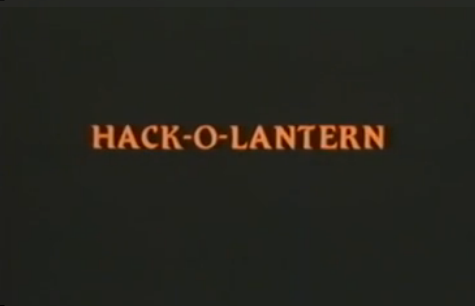
Hack-o-Lantern (1988), by Jag Mundhra


The worst part of reviewing these movies is describing them.

As I've said many times before, the goal of the A-List is to spread awareness of trash movies with the hopes that people will check 'em out and, ideally, reconstruct their notions of "good" and "bad" movies. Because these movies subvert and play with all of the cinematic conventions we've grown comfortable on (being sheltered since childhood in a Plato's Cave of exclusively good movies...usually), putting them in precisely-defined terms is the most important part of "selling" their value. (More a spiritual and emotional value than a capitalist one, to be sure.) While it is easy for me to simply proclaim the greatness of these films, that method is not effective. And there's always an unsteady balance between revealing the fun and spoiling it. But what complicates the issue further is that there is always an indescribable aura of good in them. An intrinsic sweet substance that flows richly from them, that touch the heart and destabilize the mind. Maybe it's masochistic guilt, or sadistic schadenfreude against the poor souls who tore their chests open to the world and fell so hard. Or soared so high.

Today's movie, fortunately, is one that presents that magic, invisible "trash feeling," while also being easily comparable to "bad movies" that people have a high chance of having already seen. I've heard people compare it to Troll 2. Both are distinctly products of the late '80s/early '90s. Both had foreign directors directing American casts (Indian and Italian, respectively). Both are fucking incredible. Good news, at this point in history statistically you probably either have seen Troll 2 or know someone who can show it to you! That will lead easily in Hack-o-Lantern. Following Hack-o-Lantern may have to be James Bryan's Don't Go in the Woods, or maybe Furious. The goal is to get you to like Manos: The Hands of Fate, and then send you down into Ax 'Em, and finally Hip Hop Locos. It's nearly impossible to get any sort of enjoyment out of what waits on deeper levels, like After Last Season, Where the Dead Go to Die, and Alien Beasts. Love is not applicable to them. They are not even movies. They are Creatures.

This movie gets off to a great start--we have a relatively innocent setup where a young boy named Tommy meets with his grandfather, who is very sweet, if overdramatic and possessed of a voice that sounds like Beetlejuice after six packs of Red Apple cigarettes. Of course, he is a Satanist, who teaches Tommy that blood tastes good and drinking it makes you healthy. Also, he kills Tommy's father by burning him alive. But this is just the beginning. If you think that this movie holds back its weird twists and somehow becomes normal after this intro, you are dead wrong. It's revealed that Tommy's grandpa is incredibly open about being a Satanist, and apparently happily revealed to his daughter that he killed her husband. He even keeps one of his bones on a necklace, which he shows off to her while groping her. It is a scene that is gross by default, true, but the whiplash pacing, poorly-chosen soundtrack, absurd line delivery, and unsettling stylistic changes (rustic thriller to Hammer Horror to POV '80s slasher depending on the scene) make nothing in the film come across as truly fucked-up. It's laughs all the way through, even with some occasional slow bits. Where will Tommy's dark destiny lead him? To heavy metal? To a cool-looking demon mask and burying people alive? Or even to the horrid depths of branding someone's buttcheek with a pentagram...?!

This is one of those films where you can let it play in the background, and 90% of the time when you turn back to it, something crazy is going on. Ass-branding aside, this movie is full of nonsense. The grandpa's mouth is always of both scenery and an ever-worsening Southern accent. People have sex in a graveyard on top of one of the graves. And even dedicated fans of soap operas will be shocked and intrigued by how many times people have the same repetitive conversations about relationships. In all of this, there is perpetually a sense that everyone involved had great fun and they wanted you to have great fun as well.

The issue is, they had to get it to feature length, and thus there are a lot of shots that are just plain uninteresting. Some of them are too dark to see, and others are visually dull next to vibrant shots lit by mood lighting (such as at the Halloween party, which, like everything else in the movie, is full of EIGHTIES). So again, feel free to zone out--just expect to be dragged back in rather hurriedly when the dull shit is over!

I'm always impressed by how this movie, via having the garnishes of poor acting and all the other stuff I mentioned, manages to thrive despite being incredibly generic for an occult thriller. The scenes of Satanic rituals--and indeed, Satan himself is the evil here, because it's not like he's overdone or anything--consist of people in black robes dancing around candlelit pentagrams and drinking from chalices. That's it. It is the original, generic, archetypical "Black Mass" scene. Even the movie's tenuous link to heavy metal had been beaten to death by the '80s by the time this movie came out. Do not come here looking for an original story. The presentation of the story is what matters, because they did indeed manage to fumble literally everything. Everything except showing off lots of boobs.

That combination--failure and simplicity--make Hack-o-Lantern simultaneously charming and spooky. It's great on Halloween, as if you couldn't tell. While it will not frighten you, it may potentially give you goosebumps, which if you're like me will give your life more meaning. I live for spooky shit. I die for spooky shit. And I like laughing at this nonsense.

And sharing it with you, of course.

Hack-o-Lantern is a syzygy, a fusion of two opposites. It is both entirely relatable and entirely alien. It's something that you can jump on no matter what of stage of life you're in, as well as a gateway to something greater. Hack-o-Lantern doles out perspective, and through perspective, we have understanding. And understanding leads to a better world.

Wednesday, January 6, 2016

The Soultangler (1987), by Pat Bishow


"After life--after death--the madness begins!"

And what great madness it is. Long Island is a place I've never visited, but want to go to now more than ever. That may be odd for some people (including Long Islanders themselves), but I have always seen it as a faerie-tale world by way of infamous teenage director Nathan Schiff. Schiff, who will inevitably appear on this site at some point, created four films of bizarre and disgusting elegance, beginning with Weasels Rip My Flesh in 1979 and ending with Vermilion Eyes in 1991 (he did also make 1993's The Last Heterosexual and 2008's Abracadaver, but I haven't found the former and the latter lacks the magic). Schiff's films are surreal, intellectual, and vomit-inducing, and all of them have earned a special--or infamous--place in my heart. Long Island occupies that same place. Now, it seems to be a veritable nest of miracles, as today's film, The Soultangler, was also made in Long Island. It's safe that say that that particular part of New York is on its way to becoming the lunatic trash capital of the world.

Doctor Anton Lupesky has created Anphorium, a drug that allows people to transfer their souls into corpses and control them. The corpse must possess eyes for this to work, for after all, the eyes are the window to the soul. Despite his accomplishments, however, Lupesky is "evil...an agent of Sey-Tawn, if not the Devil himself," to quote his murdered lab assistant. Said assistant's daughter, Kim, tries to investigate the circumstances behind her father's death. Kim is an incredibly cool lady. When her boss at the paper doesn't listen to her, she hangs up his phone call to yell at him. She also smokes cigarettes, which the movie reminds us of many times. Slowly, we learn that Lupesky really is evil, as evidenced by the goofy faces he makes as he covers himself in skull-blood, and by the fact that believes by way of Descartes (?) that women have inferior souls. He explains the latter point when on a date with his boss. When Kim visits Lupesky he gives her Anphorium, causing her to hallucinate up some zombies. In the final showdown, almost nothing will be spared from a spattering of both gore and ludicrousness. There are zombies, including one who garrotes someone with his guts. All along the way we get a lot of talk about the soul that manages to avoid being all New Age-y and awful. I feel like it's a movie that tries to say something about the soul, but maybe doesn't.

Because of its metaphysical subject matter--or its attempts at such--Soultangler is an inherently surreal film. Shirtless men rub their hands over yellow walls. Closeups of eyes occur frequently. Stop motion abominations have tarantulas crawl on them. The stop motion in this movie, by the way, is amazing, and in fact all of the effects are. The film seems very professional: it has a full cast and crew, great cinematography, and experienced, if sometimes crazed, editing. There are still enough line flubs, acting failures, and awkward camera glances to make it clear that this was still a production made by one of us Little Guys, not a big studio. It is a mixed beast of the most entertaining sort, and it is a legitimately good movie that happens to be batshit weird. But it still all makes sense, even if you have to watch it a couple of times. But you should be doing that anyway!

I really can't allow myself to glance over the depth of the sheer oddity of this film. Much of the dialogue, especially Kim's father's narration, is incredibly over the top, to the point where it gives the movie an almost pulp-like quality. Actually, this would make an excellent villain pulp, with Doctor Lupesky, of course, as the villain. He has some creepy goons working for him, including a heroin addict who goes for the ever-creepy Texarkana Phantom Killer look from The Town That Dreaded Sundown (which, incidentally, was also used for Bruce from Nathan Schiff's Long Island Cannibal Massacre).

Then again, a pulp probably wouldn't have the trippy dream sequence where Kim is attacked by a zombie priest whose speech is slowed down and backwards. Even the Great Shit of Yore isn't perfect. And Soultangler isn't perfect either--there are some tonal transitions (usually in the form of oddly-placed comedy bits, including Three Stooges doorway schitck with Lupesky and the heroin addict), which may throw people off, even though they were great for me. And for me, at least, it probably is perfect.

It is a film that builds slowly, like a sports stadium built with too many taxpayer dollars. In the beginning, yeah, we do get Lupesky tripping the fuck out. But it has nothing on all of the chaos of the the finale, what with its plethora of cackling faceless corpses. It is never boring because there is always something else great on the horizon, whether it be the graveyard-monologue dubs or the out-of-control latex creatures that populate this fascinating landscape.

The world of this film is a place of madness. And the madness flows richly from New York.

Long Island or bust--I'll make it someday.

P.S. This movie has a pretty rocking soundtrack. Even if the end credits music is apparently just a recording of someone puking.


I'd like to give a special shoutout to Bleeding Skull and their amazing movie label, Bleeding Skull Video. Without Bleeding Skull Video I never would have seen Soultangler, and indeed, without Bleeding Skull's amazing reviews, I wouldn't have encountered the magnificent world of trash cinema. 

Saturday, November 28, 2015

Witchdoctor of the Living Dead (1985), by Charles Abi Enonchong


Witchdoctor of the Living Dead wastes no time in letting us know how fantastic it is. After all, how ballsy is it to open the film with a title card reading "WARNING," only to have no text follow such an exclamation? How equally ballsy, then, to show the opening not once but twice? Witchdoctor of the Living Dead thus informs from the start: "I am not a movie. I am a revelation. And I will end the world you know."

Welcome to the apocalypse, straight from Uganda! Horror cinema in Nigeria and Uganda has achieved minor urban legend status for the ludicrousness of the cinema they produce. From mindbending tales like End of the Wicked to epic serials like the four-part 666: Beware the End Time is At Hand, shocking camcorder effects, inexplicable dialogue, and incomprehensible editing are the names of the game. Unfortunately, many of these films are used by fundamentalist Christian groups to forward harmful and oppressive agendas--a context which can't be easily separated from the films on display. But when viewed independently of the real world, they are works of art that represent glimpses into a world as surreal as the low-budget cinema of Turkey or Indonesia. The types of movies this blog concerns itself with can be found all over the world, and each country does it different. We live in a cultural rainbow of beautiful trash and I am only just discovering the tip of the iceberg for African talent...and gorgeous madness.

A taxi driver takes his fare through the dusty Ugandan roads. He attempts to strike up a conversation, only to learn that his passenger is in fact a skeleton. He screams and the editing leads us to believe that the skeleton is screaming back. He flees only to be confronted by zombies. Shots of the zombies consist of accelerated slideshows, ala most of Andreas Schnaas' Violent Shit. The driver returns to the taxi, only for the skeleton to vomit snakes on him, leading to his demise. We go into the (second) opening credits sequence, wherein music that sounds like it would fit in the 1990 Captain America movie plays. It's okay, though, because the movie's soundtrack is also cobbled together with music from Godzilla, Dawn of the Dead, and Satan War (probably a library cue, but whatever).

In essence, the titular Witchdoctor of the Living Dead (spelled "Livingdead" on the main title card) is terrorizing a town full of characters who are probably named somewhere. A woman pukes snakes until she dies, a priest holds a crucifix up to the camera for ten minutes, and lines are read with the emotion and pacing of Microsoft Sam. All of this makes the movie incredibly hard to follow, and that is why I love it. What I don't love is a goat being bloodily killed in real life on camera. It's entirely unnecessary and somehow manages to become even more grueling than the animal cruelty shit from Cannibal Ferox. However, that's basically the only dip in the road. This movie may bore a lot of people, but not too many, really. I really doubt you could get goofier zombies, and I'm counting the ones from Zombie Lake--it is genuinely entertaining merely on an aesthetic level for the zombies alone.

There are two questions I kept asking while watching this. One, "What the fuck?"; and two, "Are you fucking kidding me?" However, both were said endearingly. There is almost no plot in this movie. Character development is nonexistent, and never established to begin with. As such, it can only be really be described as hallucinogenic; a psychedelic sea of cackling zombie faces, slow-mo shots, and an ending that would be disappointing if the events of it were portrayed with regards to real-life ammunition limitations. And people scream quite a lot, though the screams sound less like those of pain or fear, and more like anger. I love hearing those screams in movies, for how out of place they are, and I've found out through making my own movies that it's really the only way to do any sort of genuine scream while acting (assuming you're like me--I am an actor in the same way that cream of mushroom soup is an exotic and exciting dish). Everyone sounds pissed off over the fact that a zombie is eating their guts. I suppose that's kind of awesome. I mean, if I get killed by black magic, I want the sorcerer in question to know that as scary and painful as my death is, I'm still damn pissed off that my death means I will never taste honey-sriracha-crust mushroom pizza again.

To put it another way: Witchdoctor of the Living Dead has basically everything I could ever want in a horror film. The only other time I've felt such a thing so deeply was in Evil Dead, particularly in the wake of the scene where the Deadite grabs Ash's ankle while screaming "Join us! Join us!" Ghouls screaming "Join us!" has always made me laugh myself to tears.

I like to think that Witchdoctor could one day give someone else those same tears. Do yourself a favor and track it (just fast-forward through the animal violence). Then you will finally find out for yourself what the WARNING is. Or rather, why they didn't have time enough to tell you what that WARNING was. Because it is a WARNING that this movie is full of all kinds of batshit glory.