Showing posts with label fantasy. Show all posts

Wednesday, May 8, 2019

Starcrash (1978), by Luigi Cozzi


It's time.

As far as I understand, Starcrash is an equal of Troll 2 and Birdemic as far as Famous Bad Movies go. Maybe it's not as famous--but until Troll 2 kicked off its reign as a Bad Movie Prince, Starcrash was possibly the most famous Bad Movie made by someone from Italy. Nearly everything about Starcrash is done badly in some way, but the cohesive whole is never annoying or agonizing. Far from it--the film is pure trash fun, in a nearly classical sense, and some parts are even done (mostly) well. Of course, there's the fairly obvious caveat--see that title? See that release year? Hope you're ready to take the fast train to Cashinsville.

This movie opens with a shot which has by now become classic--thanks to a different movie. Hmm, what other science fantasy motion picture came out in the late '70s that opened with a spaceship flying away from the camera, descending off the top of the screen? The name escapes me at present. Anyway, our decently impressive starship is manned by a bunch of guys who look like the Time Lord Chancellery Guards from Doctor Who. We will learn later that they serve the Galactic Emperor...who is a good guy in this one! See, this movie is totally original. The Imperial crew are wiped out by flashing red lights, which the film's characters insist on calling "red monsters." Um, sure. They use the same effect to make the stars of the space scenes, changing the red lights to white. Anyway, after the rampage of the "red monsters," we cut to our heroes, smugglers Stella Star and Akton. They are on the run from the Imperial authorities, represented by a green, bald, human-like alien named Thor and a robot named L. Thor's green skin ends at his neck in some shots, and L speaks with a Yosemite Sam accent. Later, he'll turn out to be a coward because they couldn't have him roll around and speak in beeps. Stella and Akton escape but end up at the border of "the Haunted Stars," a deathzone of uncharted cosmic territories. Here, they find the Imperial ship, with a single survivor left aboard. Before he dies, Akton reads his mind, because as we will learn wayyyy later in the movie, Akton has the Force PSYCHIC POWERS. Stella and her friend contemplate contacting the Emperor to let them know what happened on one of his missions, because they are the Good Samaritan sort of smugglers. The choice is removed from their hands when it turns out Thor and L managed to track them after all. They are arrested and tried by what I swear to God is the thing from the end of the 1953 Invaders from Mars, stolen wholesale and dubbed and greenscreened over. What's weird about this trial is that the not-Martian sentences Stella to 200 years hard labor, but then sentences Akton to life imprisonment as well as hard labor. This is odd because normally 200 years is a life sentence, but this is the future, so who knows.

Speaking of the future, did you know that leather bikinis will become standard for female prison laborers in the centuries yet to come? Well, actually, it's just for Stella Star. Don't know what makes her special, but she'll keep on wearing this outfit for damn near the rest of the movie. There are multiple opportunities for her to change, but she just sort of doesn't. I guess it would be comfy if you did a lot of running on planets where modesty wasn't a huge issue. Stella is surprised when Thor and L show up to collect her--she and Akton are no longer the Emperor's prisoners, but his guests. They were the ones who met the dying guard, after all, which gives them at least a tangential reason to meet with the ruler of the galaxy. The Emperor--whose privileged, uncertainly-ironic air gives him a strange resemblance to Prequel Palpatine--asks Stella, Akton, Thor, and L to go into the Haunted Stars and looks for the "phantom planet" of his evil counterpart, the wicked Count Zarth Arn. Indeed, it was Zarth Arn who sent the "red monsters" to attack the Imperial ship, which was one of several being sent into the Stars to combat the Count under the command of the Emperor's son. As with all the crew of all the ships who sought Zarth Arn's planet, the Prince has been lost, and the Emperor fears the worst. Stella promises to bring him back one or another, and the quartet leaves, with all prior grudges seemingly erased.

The first planet they go to sets up a formula which will follow for much of the rest of the film. Stella and L take the ship's shuttle down to the planet, while Akton and Thor stay aboard and uh. Tend to the machinery, I guess. Or maybe they "tend to the machinery"--hey, it's a great way to deal with boredom. When we do cut to Akton in the ship, he's practicing making plasma rings or something with his psychic powers. As she explores the beach, Stella utters one of the best lines of a movie made up of best lines: "Oh my God! Amazons on horseback!" L's reply is relaxed, despite his newly-acquired and oft-proclaimed nervousness: "I hope they're friendly." They are not. They take the pair back to their queen, an ally of Zarth Arn's, and when they try to escape they attack L en masse. This movie is another occasion outside of Death Note where I must be careful spoiling that L dies. Except not really--he just gets back up and saves Stella, but not before the smuggler learns from the Amazon queen that Zarth Arn's planet is protected by two guardians. The movie does remember this later, but the payoff is really stupid. Stella and L try to go back to the ship, when they are attacked by--and I'm not kidding here--a giant humanoid stop-motion robot with enormous spherical tits, complete with giant blown-out industrial nipples. The not-Harryhausen creature stumbles after them but they manage to get away safe and sound. Of course, they have to shoot down some Amazon fighter ships along the way, in a sequence which is similar to the TIE fighter scene from A New Hope in spirit if not in totality.

The next planet is an ice-world, just like in Star W--wait, hold on. This movie came out before The Empire Strikes Back. Surely it's just a coincidence, and not an instance of George Lucas having seen this movie. Anyway, it turns out Thor is a traitor, and he plans to leave Stella and L on the planet to die, after having seemingly killed Akton with a single karate chop. Akton is a little bit stronger than that, though, and shoots lasers out of his hands to kill Thor (making a creepy murder-face in the process); he saves Stella and L, but not before they have a genuinely cute bonding moment where they call each other friends and reminisce about how far they've come since the days of fighting each other. It turns out Akton knew Thor would betray them because he has future-vision. When Stella reasonably asks, "Why did you never tell me about this before?" his reply is totally amazing: "Because if I told you the future, that would be changing the future, and that is against the law." (Emphasis mine, but some words don't need to be spoken intensely to be emphatic.) I assume this is a weird dubbing thing, and they mean, like, the laws of reality, but I love the idea of the Emperor meticulously studying the future and then enforcing its flow no matter what, including the parts of it which don't go well for him, and dispatching time-cops--dressed perhaps even more ludicrously than their chronally-bound counterparts--to punish those who try to change the future. All while pretending not to know what's going on.

In orbit over the third planet, the heroes' ship is attacked by the "red monsters," but Akton reveals that they are actually a psychic illusion. While on the planet, Stella and L are attacked by cavemen. While the pair hold their own, the cavemen are great in number, and they attack L en masse. This movie is another occasion outside of Death Note where I must be--oh goddamnit! This movie needs to stop repeating itself. This time, L is really, truly dead, at least for now. Stella has been kidnapped and is about to be cooked and eaten when she is rescued by a figure in a fish-man mask. He takes the mask  off of his head, and reveals his true identity: DAVID HASSELHOFF. Again, I am not kidding, it is actually Hasselhoff. Hasselhoff with a fuckton of eyeliner, no less. This is Simon, and he is the only surviving Imperial from the original wave of ships that entered the Haunted Stars. He and Stella run into Akton, who whips out a lightsaber (there's no other name for it) and cuts down the cavemen who were chasing them. He then says that the red monsters and the cavemen were the twin guardians spoken of by the queen of the Amazons--thus, the planet which contained the last survivor of the Emperor's mission was conveniently also the base of Zarth Arn's they were looking for. Those are not interesting guardians, although the Count has a pair of really shitty stop-motion robots to protect him--a simple dialogue transplant would have fixed some things, because it's more likely to me from a story perspective that these robots are the guardians, and not two unrelated, random menaces. It turns out that Simon is, of course, the Prince, and the Count is using him as bait to come to the phantom planet--whereupon he will blow it up in his face, killing the galactic ruler alongside his son and the two smugglers. But Akton breaks loose and kills the robots with his lightsaber, sustaining fatal injuries in the process. He refuses to save himself because changing the future is against the law and everything. But he dies giving the universe a better chance.

It seems that Stella and Simon are doomed to die anyway, because they can't escape the planet--however, the Emperor appears and announces he has powers of his own. At that, he commands: "Imperial Battleship...stop the flow of time!" That ship can suspend time, alright, but it can't suspend my disbelief. The Emperor announces the final plan, which involves crashing his flying city into Zarth Arn's fleet--a Starcrash, as it were. The last battle begins, pitting good against evil in a fight to the death.

Starcrash does its best to do good with plundered loot. While there are countless scenes and moments shamelessly plucked from the vine that grew from Star Wars, the sets and costumes usually have some sort of creative image apparent in them. It is entirely possible that the design team had seen episodes of Doctor Who, as that aesthetic is present too. There are odd European touches here, as well as Flash Gordon. Yet all of these elements work in their own pulpy goofiness--this is a space opera, after all, and opera is nothing if not garish. This movie is surprisingly sexless for an Italian film of this vintage. But like the model it "borrows" from, Starcrash is more concerned with an unquestioning, un-cynical world which could appeal to children as well as adults, rather than the universes of anything that the Umberto Lenzis and Bruno Matteis of the world would ordinarily turn out. Hope is valuable in Star Wars, and that Starcrash preserves the hopeful atmosphere of its better counterpart is vital. It's a bit easier to believe in the cheapness, because at no point do you feel that the characters would get annoyed watching their own movie. The scene with Stella and L on the ice-planet is, as I said, genuinely affecting, and while Akton was kind of a tool who did mysterious things for dumb reasons, his death is upsetting because we care about Stella and we know by this point how dear Akton is to her. Also, with lovable robots being more popular than ever, it's hard to watch L's longer-lasting second death, even if he does come back in a new body for the finale. A lot of people, including myself, like to say things that try to synopsize cinema as a whole, and I want to avoid universal conclusions because I love movies for how amorphous they are--all the shapes they can take, all the games they can play. But I will abide by a broad and general maxim that Good Characters + Entertaining Events = Good Movie. I don't know what I need aside from compelling characters and interesting things for them to do. Throw in a Good Message and we've got something going here.

Of course, Starcrash is very funny, and not on purpose. I think my favorite scene is the one in the final battle where Zarth Arn's idea of leading his men is standing on a catwalk shouting "Kill! Kill!" over and over again. Maybe that's all I need. I don't know what I need, actually, but I seem to keep finding great things in life anyway. Starcrash is most certainly one of them.

You can help support the site at my Patreon, and like the A-List on Facebook to get updates.

Wednesday, April 3, 2019

The Oracle (1985), by Roberta Finlay


Roberta and Michael Findlay were trash legends, it's fair to say. They made The Touch of Her Flesh and its two sequels, a film series in which someone is vaginally assaulted with a lobster claw. (Not in all of the movies, just one. I think.) It's hard to imagine a married couple being inspired by the goddamn Olga films, and then going on to make classics like Snuff and Shriek of the Mutilated. Michael met a grisly end, being chopped to pieces by a helicopter in 1977, but Roberta kept on making horror into the late '80s. The Oracle is the first of these later outings that I've seen, but what I saw not only impressed me cinematically, but it worked as great trash too. This movie's pretty intense.

We open with some good ol' automatic writing being down by downtown medium Mrs. Malatesta. (Huh, wonder if her husband runs a Carnival of Blood--no, not that Carnival of Blood, I mean this one.) She has a ghost-planchette which is about to summon the spirits responsible for her demise; the planchette's new owner comes along shortly. Her name is Jennifer, and she's a friendly, ordinary woman who is married to world's biggest jerk. Men, if you constantly call your wife hysterical and embarrassing except for when you want sex, you're a stupid motherfucker and you should put your testicles under a jackhammer. Anyway, once the landlord, Mr. Pappas--who has a Greek name but acts like a Mexican stereotype--hands off the planchette, then Jennifer starts running into trouble. And not just because her dumb houseguests make the hand spell out "I am horny." Jennifer makes contact with the ghost of a murdered businessman named William Graham, who helps her uncover a conspiracy of murderers involving an evil factory manager and a trans male assassin named Farkas. And of course, no one believes her, or believes that she's sane.

This movie actually works really well as a commentary on how women are treated and gaslit in our society. At almost no point in time do any of Jennifer's friends or loved ones consider that she could be, y'know, telling the truth. They don't even consider that her paranormal experiences could be based on completely ordinary phenomena! Maybe it's bad writing--trust me, the dialogue is pretty goddamn bad, even if it's frequently hilarious--but the world is set against this poor lady as it is for many women in real life. It's a pretty crude form of dealing with a real issue, but crudeness is perhaps what's needed. Sometimes a sword will do, but other times a club just hits a little better. Apply a little reason, chaps! If your ladyfriend goes crazy on you there's probably a cause, and not just a tilting of the womb or whatever.

The theme is so blatant that I'm not really gonna spend that much time on it. IT'S TIME FOR TRASH INSTEAD.

Alright, so this movie really acts like it's two movies sewn together, Godfrey Ho-style. There's the occult stuff and there's the murders with Farkas. They come together at the end but it's funny how far apart they are. And how awkwardly they're cut together. In between scenes of Jennifer's Christmas Eve party are snippets from Farkas' murders. He hires a prostitute who he kills after she finds out about his genitals. He goes to a diner with the world's bitchiest waitress and takes an angry phone call from the diner's phone. ("Oh my God! He even ate the bones!") He also pops a Happy Hanukkah balloon--Nazi fuck. Maybe there's meant to be an intentional play between the fun of the party and stark '80s New York apathy of these other scenes. It's not played up that way, though. It feels more like someone just had an accident with the editing machine.

Incidentally. With that facial structure, that voice, that weight, the AFABness and the antisemitism--my God, Farkas is actually Crazy Fat Ethel, isn't he? He found his true self in that stock footage mental hospital from the end of Criminally Insane 2! I knew the story continued! Now we just need a movie explaining the Janowski family tensions between Ethel/Farkas and his sister, Edith Mortley RN.

Then there's the supernatural stuff. Pappas ends up with the planchette at one point, but he tries to use it to figure out the next day's lottery numbers. Because that's what communing with the dead is for. He is attacked by slimy rubber kids' toys, who start drinking his blood; when he tries to cut them off with a knife he just ends up mutilating himself instead. Then there's Jennifer's visions. She sees a shitty-looking corpse on TV, a clawed boogeyman at the window, and finally the zombie of her landlord. At the end there's another bad-looking rubber corpse who we get to see in even more detail. All they could afford was rubber and slime. Frankly though, that's all you need to make a great horror film.

There's just one more thing I want to comment on. When Jennifer says she has a surprise, her husband rolls his eyes and murmurs, "Antique pistols." What?! Why would he think that's what she had? Did he think she was challenging him to a duel? Is showing off one's antique pistols a common occurrence in this couple's social circle? I don't know why this baffles me so much. I can understand this from a first draft perspective--lord knows how many jokes or bit of dialogue I've written that have made sense in the moment but have proven baffling on the return run. (That's right, you guys get my good material. Crumble in despair as you consider how dire my bad shit must be.) But this was just odd. Odd in a way that I love, naturally, but odd all the same.

If you like slime and communicating with the dead, then this is the movie for you. It actually feels like a "real" thriller at times, before someone opens their mouth and says something. Professionalism is on display. But not everywhere. It's that precise and unique dichotomy that really matters.

You can make reviews like this happen via Patreon! And you can like us on Facebook to get updates!

Wednesday, March 13, 2019

Continuity Cavalcade #2 - Supernatural Encounters in the Star Wars Universe


Joe Bongiorno has turned out one of the most continuity-heavy Star Wars Legends pieces yet! And you'd better believe that it turns everything you know about Star Wars upside-down.

You can get early access to the podcast on Patreon (www.patreon.com/AdamMudman) and like us on Facebook (www.facebook.com/MudmansAList) to get updates!


Image Source: www.starwarstimeline.net

Thursday, February 21, 2019

Continuity Cavalcade #1 - The Master's Timeline


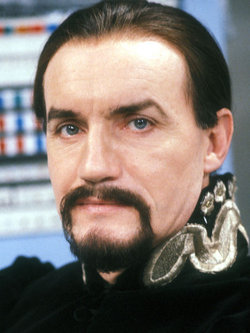
Stories can get complicated, but we're used to complicated here at the A-List. Welcome to the first episode of Continuity Cavalcade, a brand-new show all about examining what continuity is and how it works, as well as the particular idiosyncrasies of individual stories. Look forward to episodes on Star Wars, Star Trek, DC and Marvel Comics, and many more! In our first episode, we'll be untangling the timeline of the Master from Doctor Who!


Image Source: Findagrave

Wednesday, October 31, 2018

Wish Upon (2017), by John R. Leonetti


Comedy gold. HAPPY HALLOWEEN EVERYONE!!!

You can support the show on Patreon at www.patreon.com/AdamMudman and like us on Facebook at www.facebook.com/MudmansAList.

Tuesday, May 22, 2018

Thursday, May 10, 2018

Black Devil Doll from Hell (1984), by Chester Novell Turner


Black Devil Doll from Hell opens with this proclamation: "We all have our personal horror stories to tell. May yours never be as devastating as Miss Helen Black's." I'm glad that director Chester Novell Turner decided to include this expression of sentiment. Because now, I dread the day where I find an antique shop that sells a ventriloquist doll which will not only molest me, but call me a bitch over and over again, until I am driven mad. Verily, there is no worse fate on this Earth, save for perhaps enduring an existence without Black Devil Doll from Hell.

Helen Black is an ultra-Christian in a world of sin. Her friends call her up to brag about their gangbangs, and she runs into thieves selling stolen goods out of their car trunks on her walk back from church. She's sanctimonious and has a rather large stick up her ass, but many of her peers are just as bad. It's pretty great that her friends think they can talk about sex with her when she's told them time and time again about her beliefs on such things. Anyway, Helen eventually ends up at an antique shop where she is fascinated by a ventriloquist puppet. The store owner tells her it once belonged to an East Indian sorcerer, and it always finds its way back to the shop--she's sold it four times but it's returned one way or another every time. Helen decides to try her luck, bringing the doll home with her. Soon the doll comes to life and introduces her to the world of rape, consensual sex, and being called "bitch" every five seconds, all at the same time. These scenes are virtually indescribable because it's a woman being fucked by a puppet. When she wakes up she finds the puppet missing, and tries to replace him with flesh-and-blood men. This isn't the same, though, and she eventually remembers that the puppet always returns to the store. But you only get one try at puppet dick, because when she re-purchases the doll and tries to make it fuck her, its eyes light up and she dies from what appears to be brain hemorrhage. Fin.

This movie is upsetting on basically every level. Not only is about puppet-rape and its transformation into puppet-lust, presented as an apparent consequence for religious devotion, but aesthetically and directorially it is also a sensory mess. Scenes end too late, music comes in too earlier. The stylishly awful Casio just sort of barges in with no cares about appropriateness or dialogue mixing. For example, when the antique store owner is giving Helen the doll's backstory, a high-pitched squeal immediately breaks in and starts muting the dialogue through pure aural force. Characters will start talking but a lack of union between the cuts and cues fill their lines with unnatural pauses. And, if you want to see the "ultimate VHS movie" that's still visible through its sea of fuzz, look no further. This is SOV as fuck, and it's a miracle.

Then of course there is the script. Helen puts nylons on the Black Devil Doll from Hell, saying, "These will make you just a shade darker...you'll look more real." She follows this up with, "These are the only eyes to ever see me NEKKID...until we're married." So, is she gonna marry the doll then? When the doll pops out to knock Helen unconscious, not only is he played by a child, but the soundtrack appears to consist of velociraptor noises taken from a nine-year time-portal opening up to a showing of Jurassic Park. It just gets better and better.

The rape scene is simultaneously disturbing and laughable. We get lines like "Now that you have smelled the foulness of my breath, you can know the sweetness of my tongue" and "Heeeeeere's Johnny!" The foul breath in question is represented by filling the dummy's mouth with dry ice. The actors also go all-out on making sex sounds, so it does sound like porn if you look away. But when you look back, it's a two-and-a-half foot tall puppet fucking a human woman. There is no preparation for this.

Somehow, the whole affair does manage to be a little boring at times, due to a large amount of padding, but this simple tale contains enough vomitous horror for everyone and anyone who can dare its cruel mysteries. Just be ready to get shocked to your soul.

If you want to help out the A-List you can subscribe to my Patreon! You can also like the A-List on Facebook to get updates!


Tuesday, May 8, 2018

Miracle in Paradise Valley (1948), by James M. Constable


Safety films, like a lot of things, work best as a story. There's no better way to drive your message home than to wrap it up in something that people can sympathize with--and if sympathy is not your aim you should at least give them something to look up to, to inspire them to change. In some ways, safety films are like propaganda, only there aren't too many folks out there wanting to suppress human rights or blow people up in the name of watching out for loose nails. Though sometimes it certainly seems like it. Most of us have, in some form or another, seen a narrative-driven safety film, through our school experiences, or through the shorts they ran at the start of Mystery Science Theater 3000. These exercises in supreme cynicism often feature implausible characters thrust into easily-written situations which yield horrifying possibilities upon the use of the most rudimentary thought. Through MST3K, the world was introduced to abominations like A Case of Spring Fever and Mr. B Natural, which featured thin stories meant to be used as skeletal supports for the ideas and ideals of the filmmakers. Miracle in Paradise Valley ramps up the narrative a little bit for a safety film, pushing it into comfortable A-List territory--it's also one of the few safety movies of its ilk I've seen that comes close to being a feature, coming up just shy of 40 minutes. On top of that, it's probably a ripoff of It's a Wonderful Life, so there's more than a little to discuss here.

John is a relatively impatient farmer who is working his way back home along a narrow ridge when his tractor engine cuts out. A mysterious man in a suit and bowler hat comes out of nowhere and shows him that if he's not too careful he's going to roll his tractor over the edge. It is here that the man demonstrates supernatural powers, knocking the tractor off the edge and then reversing the event in time--John seems to implicitly understand he's in the presence of a guardian angel. The angel calls himself "Joe, the Special In-the-Meantime Agent"; he takes care of people "in the meantime" before their death. He's decided to take care of John because he "saved him some trouble" by rescuing his fellow sailors during a torpedo incident from World War II. Thus begins John's personal Hell, as Joe begins stalking him, getting increasingly angry as John puts himself in more and more danger, and passes over each incident as unimportant. Joe's invisibility means that John ends up socially isolated when his friends hear him shout at nothing. Eventually, John is taken to a world where his apathy over safety has its consequences--most of his friends are dead, the victims of little things John never thought would matter, like rusty nails, or inappropriate use of kerosene. This leads John to decide to make his town's Safety Fair a huge success, by breaking onto people's property and planting skull-and-crossbone logos all over the place. People mock the Fair when it finally arrives but John's rabid passion whips them back in line, so they finally devote themselves to the proper cause of household accidents, and thus avert the dark future Joe showed to John.

It's kind of amazing just how perfectly this movie fits the archetype of many of the PSAs that would follow it--while also improving on the formula, by trying to give some degree of backstory to the characters by briefly describing their wartime experiences. We have a story of a man whose minor mistakes open him up to the intrusion of a supernatural presence which claims to be benevolent but gives every indication of being infernal. Said presence torments him with illusions and social stigma until he becomes a fanatic pawn of the supernatural being's personal ends. It is incredibly easy to substitute Joe with Coily the Spring Sprite, though Joe at least has a human form for us to contend with, and his concerns are ostensibly with preventing death, which contrasts Coily's mission of punishing those who don't respect springs. However, that Joe claims death as his domain makes him seem very sinister indeed. He acts like Clarence from It's a Wonderful Life, but his involvement with John's torpedo incident makes it clear he's much more like the Grim Reaper. He also says he "has many names," which is a rather Satanic proclamation. True, it's unlikely Satan would be this helpful, but we never quite get the feel that Joe's an agent of God either. He ends up with the line, "It ain't so easy putting people back together, y'know," when he reassembles John's tractor, as if he speaks from experience. Brrr.

But that's just the start. I would argue that refusing to replace one's ladder rungs is hardly a reason to teleport someone to a phantom world where all of their friends died horribly in a single year. They really pour it on once they hit this ghost world, as you might expect, not only killing a woman in a kerosene fire but forcing her husband to give up their girls to the orphanage as well--cue obligatory long-walk down the road to the orphanage door, as sad music plays. This is triggered by John asking, "But what about the kids?!" to which Joe only responds, "Oh, you'll see..." as if we're about to see a pile of severed child body parts.

Then, there's the whole deal of planting skull-and-crossbones all over people's farms. If I found a bunch of skulls all over my farm, and inside my house, I wouldn't assume it was a friendly neighbor promoting a local Safety Fair. I would assume that terrorists were threatening to kill me. Once they arrive at the Safety Fair everyone transforms their fear into bad humor. The line, "Those skulls scared my cow so bad I thought she was gonna dry up," is enough to make this audience laugh for over thirty seconds. Then Joe makes John get up onstage, and John rants like someone deep in grief--which he is, having been forced to endure the premature funerals of his friends. It culminates with John dragging out empty chairs to represent not just the dead, but "the living dead" (!!!)--that is, one person who was blinded by an accident, and another who was apparently confined to bed permanently by one. Ableism: the secret to safety. Because when you're blind or quadriplegic, you might at well be dead, right? Blehhh.

I wanted to set out in this review to dissect the forces that create films like this, but I can't help but wonder if we're witnessing a line of progression here. This movie turns It's a Wonderful Life into a PSA--which in turn may have mutated into A Case of Spring Fever. Doesn't that make a perverse kind of sense? I don't know if It's a Wonderful Life can be cited as the forerunner of this strange undercurrent/pseudogenre of "angelsploitation" but these stories are ultimately compressed and twisted versions of tales like Dickens' A Christmas Carol, wherein supernatural forces do the good which is beyond the reach of man. At least, that's the premise of Dickens' tale and It's a Wonderful Life; Scrooge will never listen to any mortal man when it comes to letting go of his miserhood, and George Bailey's values make it too hard for anyone to negotiate him out of his suicidal emotional state. Here, though, John and his friends are just kind of idiots. They could avoid using large open containers of kerosene in close proximity to burning stoves, but they're apparently just overconfident jackasses. At this point, analysis dies, because we must presume laziness propelled these emergent themes rather than intent.

I do feel rather like I'm cheating here by reviewing this, just as I did with Cyberon. But I want to say here that this movie is pretty hilarious, and while I tried to analyze it, I more wanted to recommend it. At 40 minutes, it's a frightening little chunk of fantasy ripoff that manages to imply more graphic violence than a lot of horror films. Sweet!

If you liked this review and would like to see more like it, you can help me buy books and movies through Patreon! You can also get updates on the A-List through Facebook!

Wednesday, March 21, 2018

Book Club of Desolation #23: Powers of Darkness (1900-1901), by Valdimar Asmundsson and Bram Stoker (?)


In 2014, Icelandic scholar Hans Corneel de Roos was looking over a manuscript from the turn of the 20th Century that at first seemed to merely be an Icelandic translation of Bram Stoker's Dracula, penned by writer Valdimar Asmundsson. However, he started to notice that the manuscript, entitled Makt Myrkranna or Powers of Darkness, made some substantial deviations from Stoker's original text, and it didn't take long to realize that the book was something new entirely, although it was based on Dracula. The resultant text was made available in English with notes by both de Roos and Bram Stoker's great-grandnephew Dacre Stoker. Makt Myrkranna is simultaneously an awesome part of horror fiction history, a superior novel to Stoker's tale, and a suggestion of a possibility I've thought about for a long time: what if there are more books like this one, which serve as alternate versions of more famous works?

The story of Powers of Darkness roughly follows that of Dracula, but it bears repeating for the sake of this review. Jonathan--or excuse me, Thomas Harker is an English real estate agent called out to Transylvania by a mysterious noble named Count Dracula, who is interested in buying property in London. Harker is warned by everyone he encounters along the way that Dracula is pure evil, but he must carry on with his job. You see, Harker is kind of an idiot--even moreso than in Stoker's novel. Dracula is an amiable enough fellow but his castle looks like no one's lived in it properly for centuries. He also gets a hungry look in his eye when he sees Harker cut himself. Pretty standard Stoker stuff so far, but Stoker never mentioned Dracula's triumphant pride in the incestuous of his family, which produces short-lived, stumpy freaks. Nor did he mention Dracula's underground chamber where he and his gorilla-man army sacrifice villagers to Satan. Nor did he mention that Dracula and said gorilla-man army are in league with a conspiracy of noblemen who want to destroy the democratic processes of England to create a world where the serfs serve the nobles again! (I guess Dracula never heard of Wall Street, then.) Will Harker be able to escape Dracula's horrifying fortress to warn his beloved Wilma, or will he be food for Dracula's vampire brides?

"But wait!" you ask. "What about Holmwood and Quincy Morris and Lucy and van Helsing? What about, y'know, the other three-quarters of the novel?" Well, that's the thing about Powers of Darkness: most of the book is Harker trying to survive his weeks in Dracula's castle. There is a second part which features most of the same events as Dracula--the arrival of van Helsing, the vampirism and staking of Lucy/Lucia, the menace hanging over Mina/Wilma, and finally the battle against Dracula and his servants in the shadow of the vampire's castle. Where the end changes is that Dracula's castle crumbles upon his death, and then the nobles who allied themselves with him commit suicide or are murdered, ending his conspiracy. As the introduction and notes posit, this part was likely meant as an outline for what Asmundsson would write later, suggesting that Powers of Darkness in its complete form (assuming that we have today isn't the complete form) would have dwarfed Dracula in length and complexity. As it stands already, Asmundsson's text succeeds at being far scarier than Dracula, perhaps because of its choice to frontload.

Asmundsson understood the Harker parts had the best potential for horror. Dracula's wild, rambling structure gives it the feeling more of an adventure novel than a Gothic piece, which is awkward because it's told, as Powers of Darkness is, through letters and diary entries. It's weird to hear the tale of a frantic carriage chase recounted post-facto in a journal. But the bulk of Powers of Darkness reads like something someone found in Dracula's castle next to Thomas Harker's emaciated corpse--you never know which entry is going to be the last. This is broken only somewhat by the fact that, again, Harker is a massive idiot, as he pointedly does not try to leave the castle until it's nearly too late, even after witnessing Satanic rituals in progress! He is remarkably tolerant of many horrifying supernatural incidents. Sometimes, though, justifying logic breaks through. After all, it's probably more than Harker feels he can't leave the castle, as it's on a high rocky pass in the middle of nowhere, surrounded by wolves and God knows what else. There's also the fact that he came here to do a job, and at least at the beginning, much of his response to the ghoulish things he encountered is a very natural sort of confusion--perhaps he's imagining things, or maybe this is some local custom he as a privileged Londoner doesn't understand. Even if he trusts his instincts when he is sure the supernatural is afoot, he can't exactly return to his boss in England emptyhanded and tell him, "Sorry, the client was a Satanic vampire with a gorilla-man army which he was gonna use to tear down the government, no sale."

Now, this book would not be complete without the introduction and notes it provides. Dacre Stoker's introduction was interesting in its argument that Makt Myrkranna was based on Bram Stoker's private notes, and that Stoker and Asmundsson collaborated in the latter's penning of Powers. He brings up the fact that it was popular for Victorian authors to travel to Iceland, as they admired Iceland's astonishing poetic tradition; he also points out that several details from Powers match with unused story bits from Stoker's notes, such as the "hidden red room" where Dracula performs his evil magic, and the blind-mute woman who serves the vampire. However, I would caution against assuming that works such as these are made with the collaboration of the original author, because certain tropes are universal, and there are such things as coincidences. Respect the fanfic, I guess is what I'm saying. On my first read-through of the introduction I was disappointed that Dacre Stoker generally abstained from praising Asmundsson's individual creativity in the parts of Powers that weren't seemingly based on his great-granduncle's work, but a closer look-through on my part shows the integrity of his investigation. Similarly, I found de Roos' footnotes to be cluttery and intrusive at times, but they form a log of the challenges he ran into in translating early 20th Century Icelandic into English. When I studied linguistics I found the bond between Icelandic and English one of the most fascinating my professors discussed: modern Icelandic and Old English are extremely similar. In fact one of my professors told me that if an Anglo-Saxon time-traveler from pre-Norman England landed in today's Iceland they'd probably be able to have a reasonable conversation with someone there.

Overall, this new edition of Makt Myrkranna is an awesome look at vampire fiction history, and one of what I hope will be many discoveries of other pseudo-classics cloned from books that history remembered better. And, similarly, it's better than the original Dracula. Horror fans can't afford to miss out.

Books are pricey, but you can help sponsor the Book Club of Desolation on Patreon! Plus, you can like the A-List on Facebook to get updates.

---

Image Source: Amazon

Thursday, March 8, 2018

Horror Express (1972), by Eugenio Martin


We're going to be doing two train movies over the next two weeks, and if you've been keeping up on things here on the A-List, you can guess what the second one is going to be. For now, we'll be covering Horror Express, a legendarily bizarre Spanish-British sci-fi movie starring Hammer greats Christopher Lee and Peter Cushing. Forever full of unexpected twists, Horror Express brings more than just star power to the table, and while it somehow manages to be boring at times, it's definitely not something horror fans will want to pass on.

In 1906, Dr. Saxton (Lee) is transporting some very precious cargo back to England from Tibet--the frozen mummy of a 2 million year old proto-human creature which may have ties to the yeti. He is irritated by the presence of an old colleague of his, Dr. Wells (Cushing), who is overly curious about the nature of his finding. Before boarding the Transiberian Express, he is additionally irritated by a priest, who tells him his cargo is of the Devil--a statement somewhat easy to believe, given the dead man with the turned-white pupils found mysteriously at the perimeter of the crate; similarly, the priest is unable to draw a cross on the crate with chalk. Saxton, being Christopher Lee, dismisses all of this as rubbish and poppycock and soon he, Wells, and the yeti are aboard the train. Wells eventually pays a porter (VICTOR ISRAEL!!!) to peer inside the crate, but little does he knows that doing so will awaken the yeti's demonic presence. It slowly transpires that the "yeti" was merely the host body for something ancient...and alien. Indeed, by gazing into the retinal images of the dead yeti (in invocation of optography, my favorite pseudoscience) they determine that whatever was wearing the yeti was an extraterrestrial presence left behind on Earth 2 million years prior. All that time, this creature has been waiting for a chance to escape--and it doesn't care who it has to possess or slaughter to leave Earth.

Though there are suggestions of the supernatural--or rather, the super-scientific, for one can assume the alien's powers of possession are merely an evolutionary quirk of its race rather than an employment of magic--from the get-go, I seriously went into this just expecting a yeti-on-a-train movie. That in itself would be pretty fascinating, especially with Christopher Lee, Peter Cushing, Victor Israel, and (though I did not mention him in the synopsis) Telly Savalas in tow. Savalas plays a ruthless Russian cossack who boards the train to investigate the deaths, and mostly ends up manhandling the passengers until he learns too late about the alien. Without the alien, however, this movie probably wouldn't end up in A-List territory. For without the alien, we would not have the climax where Christopher Lee fights off an army of zombies, a feat which he probably never replicated.

I really cannot understate how much subverted expectations help this movie. Even in small ways. I bet you'd never see a movie made in Franco's Spain starring the leads of the infamously-conservative Hammer Horror franchises suggest that there are powers which God Himself can't save us from. The question of faith is a big one in this movie and it is never entirely answered--merely explored. I feel it sort of works better that way, raising chicken-or-egg questions on the nature of mythology. Does the alien resemble a demon because it actually comes from Hell, or is it that ancient humans were inspired to create tales of demonic beings because of encounters with the creature? I've always enjoyed stories like this, and that it tells such a story with a light touch is definitely a high point.

The alien also invokes another expected trope when it tries to convince its human enemies that if they let it live, it will use its superior knowledge to get rid of hunger and disease. It's a trick, of course, and we don't even know if that's something the alien can do. But even if it can't, it's a testament to the alien's psychology that it employs this trick. It has learned to be a demon--and demons tempt people. That's how they get you.

Again, the movie does manage to drag in places, but originality is a mighty queen. Horror Express constantly innovates and deconstructs its own ideas while never coming across as silly or ass-pull-y for such. Alien invasion movies set in the early 1900s are rare anyway, so it's totally worth it to check out this one.

If you want to support the site you can subscribe to my Patreon. Plus, you can like the A-List on Facebook to get updates.

Wednesday, February 28, 2018

Book Club of Desolation #22: Leonox, Monstre des Tenebres (1971), by Paul Bera


Last year I took a look at the first of the French Frankenstein pulps. This year, I figured it would be nice to have the Book Club of Desolation return to similar waters--only this time, the book I read was untranslated. That's why I failed in my promise to have a monthly Book Club review up for January (on top of being sick as shit). It took me quite some time to read my way through Leonox, Monstre des Tenebres, the first of Paul Bera's six-volume series chronicling the eternal war between the avatars of cosmic forces known as Leonox and Lisa, but I found it a fulfilling experience, to say nothing of the wonders it did for restoring my knowledge of French. Even with the language barrier in place, Bera's prose reads smoothly and thrillingly, with enough pulp action and supernaturalism to make me seriously consider tracking down the rest of the series, before all the remaining rare copies are snatched up.

Our protagonist is Lacana, a ten-time serial killer constantly on the run from the police. While hiding out in Paris, he feels a compulsion to enter a building, which seemingly contains more on the inside than it does on the outside. This is the headquarters of the mysterious organization known as "Leonox and Co." headed by, as you may expect, a man named Leonox. But Leonox is less a man than he is a demon; he possesses supernatural powers, and is in fact the embittered slave of what may or may not be the cosmic embodiment of evil, known as "the Master" or "He Who Controls Leonox." In exchange for his service, Leonox offers Lacana a new identity, including a new face and set of fingerprints--he'll accomplish this by giving him a whole new body. The first of many catches in this deal is that in order to get this body, he has to share a coffin with it. The process is a success, however, and Lacana becomes instead Francis Dalvant, a famous journalist killed in Vietnam. As part of his operations, "Dalvant" next comes in contact with the mysterious Lisa, a young woman who claims to be able to see Lacana's soul in Dalvant's body. Lisa has frequent clashes with the police for her strange statements and behavior; they think she's a drug addict. Slowly, however, Lacana/Dalvant will learn that she is Leonox's spiritual opposite, a servant of a more benevolent cosmic force known as "He Who Controls Lisa." (It's worth noting that neither of these cosmic forces are truly good or evil, it's just that Lisa is beautiful and Leonox is monstrous, both in a variety of ways.) His encounters with Lisa "reunite" him with Dalvant's old friend, the Principal of Police Princex. In the end, Lisa and Princex reform Lacana, who ultimately takes on the mental traits of Dalvant, who was an intrinsically good man. He and Lisa go after Leonox and successfully kill him after he takes control of the body of Dr. Satelm, who has the power to unleash a world-destroying plague. Lisa takes the rap for the murder, claiming she was Satelm's jealous mistress, and goes to jail--but to Lacana/Dalvant's delight, she escapes, and he begins traveling the world in search of her.

It's amazing how well Leonox, Monstre des Tenebres fits the formula of English pulp stories, and how well it pulls it off too. It's something of a random events plot, yes--now Lacana is poisoned with curare! Now Leonox is trying to unleash a plague!--but it also taps into the vein of worldbuilding which is so vital to pulp storytelling. So many ideas whiz past us at once. Just pages after revealing that our narrator-protagonist is a serial murderer, we are dragged into a world of the magical and inexplicable with the cosmic distortions of Leonox's headquarters. From there we have body-swapping, celestial war, and living burials. Oftentimes, the descriptions of the spiritual aspects of Leonox and Lisa come across as Lovecraft-lite, or Lovecraft processed through fairy-tales--sparkling and glittering, but also vast, unknowable, and perhaps most properly, incomprehensible. All of this is presented in a style which is both simple and compelling.

I really should say how grateful I am for the simplicity of the style. A lot of key points are repeated again and again, which helped me get through the plot in the case of my translations failing the first time around. (I'm still embarrassingly vulnerable to false cognates.) However, this style is also probably the book's greatest weakness--as compelling as it is, the tendency to repeat does get a little silly at times. "It was incredible that I, Lacana, ten-time killer, could be standing here in the presence of the police!" is a phrase that comes up over time and time again. Yeah, I imagine most serial killers would be shocked at rubbing elbows with the cops after making their faces known, but we don't need to be told that so often. Lacana also has a tendency to forget that he is now Francis Dalvant for too much of the book, and he keeps chanting that he has new fingerprints over and over again. These parts can be glazed over once you get the rhythm of things, though.

I keep thinking about how cool it is to have the main character of the book be a serial killer who slowly redeems himself as pieces of another man merge with his persona. I'm pretty sure that Dalvant's spirit is actually coming back and that's what's causing Lacana to take on his traits--eventually their reference to themselves as two people seems to transcend metaphor. Lacana/Dalvant is thus of dual nature, good and evil--though Dalvant wasn't purely good, nor was Lacana purely evil. Setting up this dichotomy furthers the book's themes of good and evil by making our lead(s?) into parallel(s?) of Leonox and Lisa, albeit with human drives that the reader can understand. Bera seems to believe that Good and Evil are important concepts to mankind, but they also have gray areas and spots where they blend--how very '70s of him! It's notable too that Christianity doesn't enter the picture at all; neither of the forces behind Leonox and Lisa are aligned with God or Satan in any way.

I say this is a book that reflects the '70s, but it's also French in a way that reminds me of why I love French media. It makes sense to title the series after Leonox, and to have the protagonist be a reforming serial killer, when this is a story coming from the same country that created not only the Grand Guignol, but Fantomas, the ultimate villain-pulp protagonist and grandpappy to Diabolik, Killing, Kriminal, and all those other groovy, creepy masked thieves and killers who spread through Europe and the Middle East throughout the middle of the 20th Century. France loves its villains, and Leonox was no exception...even if he's largely forgotten today.

The chronicles of Lisa and Leonox are practically begging for English translations, and I would eagerly snap those up if/when they ever came along. Despite some minor flaws, this was an awesome read and I would love to see what happened next to these characters. Longue vie à Leonox!

If you want to help me buy books, a Patreon subscription definitely helps! You can also get news about the A-List on Facebook!

Thursday, February 15, 2018

The Nightmare Never Ends (1980), by Phillip Marshak, Tom McGowan, and Greg Tallas


Ah, yes. With this, we move one step closer to getting to review Night Train to Terror, the greatest anthology film of all time and "sequel" to Gretta. You know how much I love Gretta and this one is a worthy prequel to this little fucked-up series that Night Train of Terror forces them all into.

James and Claire Hansen have only a small shortage of troubles in their life. James has fallen under criticism for the publication of his anti-religion book, God is Dead, and Claire has begun having strange nightmares of "devils and demons." When she goes to see a stage psychic in Vegas, he unlocks visions of Nazi Germany. Around this time, police lieutenant Sterne (Cameron Mitchell) begins having trouble with an elderly Holocaust survivor named Abraham Weiss, who is insistent that a 20-something rich socialite named Olivier is one of the Nazis who killed his family during the War, despite the fact that he's decades too young. Soon Claire and Sterne meet in the middle and begin to find out that they are wrestling with Satan himself. And Satan has his eyes on James Hansen, whom he believes is the perfect vessel for killing God once and for all.

I wrote that introduction based entirely off my memories for this movie, hopeful that it would live up to my expectations. Sure enough, the mental note I tagged to this film--"As weird as if not weirder than Gretta"--turned out to be accurate. The two films are similar but I don't yet know if there was ever any connection between them. Both of them have the same brand of horrible editing and odd cardboard acting that only '80s can provide. Claire in particular is horrible and as such she makes a very strange choice for a protagonist. But then, I've followed movies that featured Chesty Morgan as a protagonist and they turned out okay. The woman playing Claire isn't nearly as bad an actress as Chesty Morgan, but she comes close at times.

The Nazi angle is really jarring in this. To put things in perspective, we have no hints of Nazism until the psychic tells Claire to flash back to her dreams. Then suddenly: "SIEG HEIL! SIEG HEIL! SIEG HEIL!" and we're in the middle of SS Girls all of a sudden! Okay, I should specify that we aren't literally transported to the footage of SS Girls, but it's a party straight out of that film, sans the loads of nudity. The movie manages to handle the Nazi material well, clearly borrowing from Boys from Brazil and Marathon Man in places as far as the Nazi-hunting goes, but once we learn demons are involved, the Nazis are reduced to just being a cog in the wheel. The paranormal elements are also jarring but not quite as much--but still, you wouldn't expect a movie about Nazis and psychic dreams to suddenly feature a fucking xenomorph, would you?

I think this movie may be an anti-atheist film but I'm not sure. We're probably meant to be on Claire the Catholic's side as she spars with her husband over his rejection of religion. However, James' atheism is so ridiculous that it almost seems to be a parody. No serious atheist would use the disproof of Jesus as a historical figure as their sole evidence that all world religions are objectively bullshit--especially when said "disproof" is shockingly lazy! However, his atheism is still used for an intriguing purpose. After all, Olivier and his demons recruit James on the premise that his atheism is a pretense for Satanism. But James doesn't believe in the devil any more than he believes in God, leading to a scene where Olivier becomes something of an Inquisitor in the Christian sense, ordering James to repent his disbelief in Satan! In the end his refusal doesn't save him, however.

It's strange, too, because in this universe belief in God won't save you either. I was left with the impression at the end that this is a godless universe, or has become one, meaning the bad guys win. That's '80s horror for yuh.

The Nightmare Never Ends labors under the prospect that it really means something, or at least it gives the impression of such labor. For that reason, I think it's worthy of multiple viewings, and I know I'll return to it again and again over my life, if nothing else because the rubber monsters in it are amazing. And now that this is taken care of, we can move on to the series finale, with Night Train to Terror. This movie is already pretty weird, but imagine it now with most of its insides cut out!

If you want to make reviews like this happen, please support the site on Patreon! Also, you can like the A-List on Facebook to get updates!

Thursday, February 1, 2018

She Killed in Ecstasy (1971), by Jess Franco


As a Jess Franco fan, I consider She Killed in Ecstasy to perhaps be the film which best summarizes his triumphs as a director--to date, I am unsure which film best represents his failings. It has everything that fits the unique feel that Franco brought to the table as a director, being a distinct vision of trashy weirdness that touches on the tropes and film mechanics which Franco returned to nearly obsessively. Furthermore, it also stars not only Franco himself, but his muse Soledad Miranda and the Awful Dr. Orlof in person, Howard Vernon.

Soledad Miranda plays a young woman (never named) who ends up marrying Dr. Johnson, an ambitious medical researcher who wants to create people with greater disease immunity via in-utero hormone stimulations. For this unethical action, the Medical Council orders him stripped of his license to practice and his experiments destroyed. This drives Johnson insane and he eventually kills himself with a straight razor. Mrs. Johnson sets out for revenge against the four scientists (whose ranks include both Howard Vernon and Jess Franco) whom she holds responsible for her husband's death. She seduces and kidnaps all of them, subjecting them to gruesome deaths, until at last she joins her husband in whatever afterlife awaits him.

Pretty straightforward. There is little pretense in what is transpiring here, but that is where Franco soars. This movie has a fairly high amount of subtext, which actually gets a chance to remain as subtext. The villains of this film--the doctors who destroy Johnson's life--are depicted as what we would identify today as arch-conservatives. They are opposed to hippies, drugs, prostitution, and, as it happens, tampering with human embryos. Now their problems with Johnson's experiments are not that they, y'know, could be perceived as being what the Nazis wanted, but that they kill fetuses. What's more, they say this is not only a medical crime, but also a blasphemy as well. Indeed there's definitely a religious framing to the doctors' motivations, as, while they're not specified to be Christian, they definitely have some sort of religious beliefs which motivate their medical practices. It's easy to read this movie through a feminist, pro-choice lens, a rejection of a social order which values the lives or "lives" of fetuses over those of suffering adults and children. Some of Howard Vernon's talks about the lives of hippies, and "social orders to which [one] must conform," seem to be a genuine meditation on Franco's behalf on the idea of changing social mores and the revealed hypocrisy of the so-called moral guardians in the tide of transformation that took place in the late '60s. In a somewhat predictable twist, Howard Vernon, the most outspoken of the group on matters of ethics, is revealed to be a masochist who hates kissing and other traditional expressions of sexuality--what would have passed as a shortcut "pervert" in the '70s. What's more, the overzealousness of Johnson's opponents mirrors the violence committed by abortion opponents in real life; after all, it doesn't seem very professional scientifically to wreck a rival's lab and assault said rival's wife. That comes from a place of emotion, not cold ethics.

I still don't know how I feel about the idea of in-utero hormone manipulation, however, which is what's at stake here even if it seems to stand in for abortion. Perhaps that's where my generation will be seen as dinosaurs--as science marches on it may indeed be possible to eradicate genetic diseases and birth defects in the womb, and that may be embraced by whoever comes next as a progressive ideal. I'm wary again because to me it recalls eugenics, and indeed I can easily see those with the means to do creating children who are a step beyond, who have unfair physical advantages that will allow them to be born doped athletes, as it were. I also worry about the drugs used being unsafe and causing more harm to the children than good in the long-term, because there's a habit in the United States of refusing to do or ignoring extant research when it comes to the drug industry. I think most significantly, however, I am concerned about our primitive notions of what constitutes a "defect" in regards to how this practice could be applied--that is to say if we can detect autism in the womb, or even homosexuality, there would certainly be parents who would want those traits eradicated, and there would be plenty of doctors willing to do so. In a broader sense this would also affect the rights to bodily independence for intersex individuals as well, who already face nonconsensual "normalizing" surgeries in infancy almost universally. Technology should not serve to narrow diversity and I believe that autistic, queer, and intersex identities and bodies are vital to our society.

But anyway. Now that I've guaranteed some angry messages sent my way, let's talk about how this is a Jess Franco movie. The Franco identity is irrevocably linked to the trash aesthetic. Soledad Miranda shows up with metal pasties that have a third pasty dangling as a pendant between them. Everyone sounds like they recorded their lines in a bathtub or swimming pool, even when the characters are in small rooms or outside. The zoom lens, as ever, is abused, with nary a single shot in the whole not featuring some sort of zoom. (I wonder what the script for this looked like.) Our leads live in a creepy artsy house that makes no sense. There are pretentious poetic divergences that mean absolutely nothing. And of course, there are plenty of characters twitching and sweating in beds as disembodied voices mock them. In this case, Dr. Johnson spends a rather sizable chunk of the movie hearing the Medical Council call him "Ein Tier" (an animal) over and over and over and over again. It's one of the most hilarious things I've ever seen, or rather heard. It's gotten to the point now where whenever I see a movie where someone accuses someone of being a murderer or some such, I always have to join in their shouting with, "Ein Tier! Ein Tier! Ein Tier! Ein Tier!"

Let's talk about Howard Vernon.

First of all, his voice. I am now sure that Vernon did his own dialogue for this one, because it sounds like him from interviews and other movies where he speaks naturally, like Zombie Lake and Ogroff. This indicates to me that Vernon spoke German just as well as he did English, French, and Spanish. I really wish there was a biography of Howard Vernon available because little details like this fascinate me.

Speaking of details...

Howard

Vernon's

dick.

There's no getting around this one. I don't know who to look to in this case: Howard Vernon, for being willing to show his 57-year-old dick and balls on camera, or Jess Franco, for being able to convince a 57-year-old actor with at least some dignity to his name (he was in a Godard film, after all) to do a sex/murder scene that ends with him showing off his goods. Then he was able to do it again two years later for Countess Perverse. In this movie it becomes doubly incredible--in that I literally could not find it credible that I was seeing this--because this also features Vernon's character being castrated. To have both a favorite actor's junk in a film unexpectedly in addition to a castration scene not only rocketed this movie up onto the A-List for me but also made me severely question myself and whether or not I'll have an audience after including these details.

In all seriousness, it may sound like I'm body-shaming Vernon, poking mean-spirited fun at the body of a man just because said man happens to be aged. In truth, this scene did legitimately deepen my respect for Vernon, and sent me a vivid picture of the connection between Vernon and Jess Franco. Franco wanted to send his cast into the flames and Howard Vernon would follow him to the end. He was an actor true, dedicated to his craft, never turning in a performance he didn't put his heart into it. In truth a lot of my amusement over this comes from the fact that I may have horrified some of you who are familiar with Vernon and who never wanted to imagine that he had a nude scene, much less a full-frontal one. But here is the honest truth: if someone was in a Jess Franco movie, you can guarantee there is another Jess Franco movie where we see their junk. I'm legitimately surprised we didn't see Franco's own balls in this too.

Anyway. Like I said, She Killed in Ecstasy provides what is probably the Jess Franco experience. As we've seen, that's both for the better and for the worse. But of all of Franco's movies I've seen, this one is one of the most lively, and thus, one of the most traditionally entertaining. If you are willing to brave a whole lot of genitalia, this one will not leave you disappointed. I watched in ecstasy.

If you want to help make reviews like this possible, you can support the site on Patreon! Also, please like the A-List on Facebook to get updates!

Thursday, January 18, 2018

The Vampires' Night Orgy (1973), by Leon Klimovsky


This movie does not contain orgies. I mean, it contains night activity that could potentially be interpreted as possibly fulfilling the old, sexless definition of the word "orgy," but to say the vampires of this film have a night orgy is pretty misleading--in two languages, nonetheless! One vampire possibly has sex with a man in this movie, and even then, said man still has his mankini on when he's out of bed moments later, so it's possible the deed went undone. Despite the filthy lies of the title, The Vampires' Night Orgy is a great little trash film, a tremendous improvement over Leon Klimovsky's previous appearance on the site. 

A group of rather unpleasant people are going through the countryside to meet their new employer at their mansion. They clumsily exposit that they are each here to work as gardeners, maids, math tutors, etc. However the bus driver has a rather hilarious heart attack and they are forced to stop in another town, Tonia. Wait, did I say, they're "forced" to stop? I mean they choose to drive 10 kilometers to Tonia rather than make the full trek to their destination because they're, uh, tired. Yeah, much of what happens to the victims of this movie is due primarily to their own laziness (and other faults) rather than legitimate mistakes or circumstances beyond their control. Anyway, Tonia turns out to be pretty creepy--the local inn is obviously prepared for somebody, but the entire town seems abandoned. Doesn't stop the visitors from helping themselves to their booze, though! Eventually the people of Tonia do arrive and prove to be most cordial hosts, though that's after they descend upon poor Ernest in the middle of the night and drink him dry of blood. The mayor of the town, a man named Boris, explains that the entire village was absent last night because they were gathered in the cemetery. He says this presumably to creep his guests out, but fortunately for him, they don't find that suspicious at all, not even when he adds the detail that the town is formally ruled by a "Countess," nor when he produces a roast for them of suspiciously unique flavor when there are no livestock of any kind for miles. (We the audience get to see what happens to the poor bastard who provided said roast, from the meat of his bum leg.) Slowly, the travelers are whittled down, until only two remain--will they escape the den of the vampires before the orgy can begin?

This film is a mess, touching on all the fine ways in which a European horror film can be a mess short of just calling in Jess Franco or Bruno Mattei to direct. The soundtrack, a combination of atmospheric pieces, '70s groove tunes, and porno music, never fits a single scene. The dubbing, script, and editing are all horrible. If you have seen an especially bad Jess Franco you know just what you're getting with this--though it does contain considerably more dialogue than the usual Franco outing.

The scripting is really what makes the cast seem like such shitbags. Again, they end up in the vampires' lair just because they don't want to drive, after spending the late bus driver's last moments bitching to him that he was making them late. As soon as they arrive in town, one of them asks, "What do we do with the body?" The man closest to him shrugs and murmurs out a little, "Eh?" That's probably why the vampires go out of their way to do all but straight up tell their guests that they're vampires--they saw them abandon a dead body to go steal and drink instead. (Does that bus driver have a family, by the way?) Throughout the rest of the movie the characters will continue to stumble onto incredibly obvious signs of vampirism, like Boris drinking a thick red wine which he refuses to serve to anyone else, as they continuously do things which expose them as awful people, like watching each other undress through peepholes.

The peephole thing actually does get a bit of payoff--there's a scene later in the movie where we see an eye watching the characters through the people, and the actor on the other end has their lower eyelid pulled down, so it's just an eye swirling about in a sea of red flesh. Ughhh.

So, yes, this movie does have creepiness. There's also the subplot about Violet, the little girl of the group, who befriends a child who seems to be a vampire at first. But I guess he isn't a vampire, as he tries to hide Violet from the ghouls during a tense scene in the cemetery wherein he accidentally smothers her to death, or possibly breaks her neck. Yep--a kid kills another kid in this movie while trying to help her. That's some real Adult Fear right there. I just wish I knew if that kid was part of the village or not, because that definitely changes the context if he is.

Actually, there are a few characters whose vampire status is unclear. A lot of the villager extras don't have fangs (many of them don't even have teeth) but that's not what I mean. What's the deal with the millers who the big guy who shows up "on behalf of the Countess" keeps butchering for meat? Are they vampires? Is the big guy a vampire, even? If they aren't vampires, do they get paid for this? This isn't an unrealistic possibility because we learn the Countess is pretty free with her money--but how much money does she have if she's willing to keep around a bunch of employees who have to give up their meat (and, presumably, blood) to the local cause? I really like the idea of a vampire city like this having vampire tiers, an internal class structure, where some vampires--possibly those who were poorer in life, before the village underwent its transformation--are seen as more expendable than others, leading to a small society of disfigured vampires left to slowly regain their limbs over the course of centuries, perhaps trapped in one of the city's darker quarters...obviously I'm making up a bit of that idea but in all the "vampire city" stories I've seen, all the vampires seem to be socially equal just by merit of being vampires. This movie tinkers with that a little bit, assuming that everyone in Tonia is meant to be of the undead.

Really, if you've never delved into proper Eurohorror before, this is a good introduction. It has some actual atmospheric creepiness, but is largely a farce of badly-translated and rushed production, which actually has the audacity to try to get its badly-dubbed actors to recite Shakespeare at some point. In that sense it tries to be "artsy," without the necessary self-awareness of art, to magnificent results. Plus, there's a little nudity to give you a taste for what European bodies had to offer in the '70s and '80s. It's beautifully, primally riffable, while also presenting a strange blend of Old World charms that will delight you if you're used to American films exclusively. Even for someone like me who's seen many of these films, it's like being back at the happy start all over again, to see the tropes and accidents played out so perfectly here. Give this movie a shot, whether you're green or a vet--it's a pretty great time.

If you want to see more reviews like this, you can support the site on Patreon! Plus, don't forget to like the A-List on Facebook to get updates!

Friday, August 25, 2017

Catwoman (2004), by Pitof


Still better than Suicide Squad.

Or, if I can get a do-over: my new favorite episode of the Adam West Batman.

This movie and I have something of a history--I remember when it first came out and when I first began hearing bad reviews about it. In my first-ever issue of Nintendo Power, there was a preview for the GameCube shovelware tie-in that was about four or five pages, all predicated on the idea of the reading audience being heterosexual teen boys. Naturally they played up the sex angle of the movie as much as they could in a magazine officially aimed at kids. And when the game actually game out, they gave it 9/10. It was a mainstream gaming magazine, of course it got 9/10. In the months that passed I saw the folly of their hubris as the movie the video game was based on was torn to shreds by audiences and critics alike--I saw that Nintendo Power writers were as shameless as I am presently, liking everything they consumed without rhyme or reason. I understood a new dimension in the world of media and criticism. That brings us to today.

Catwoman is a colossal mess, but if you, like me, have had thirteen years of preparation for the moment of watching it, you will probably have a good time. It is a bad movie--a very horrible movie, as it happens. It would have been pretty devastating to have realized you paid full ticket price for a theatrical showing of this back in 2004. But in the course of writing the review for this movie I wrote down more bullet points than I ever have before for a single movie, and that's got to stand for something. The trashy moments just kept happening, and then they would cement themselves into trashy themes and trashy running gags, and soon the whole bloody architecture of the movie was nothing but rotting garbage. I haven't had so much fun with a trainwreck of this magnitude since The Room, which this movie weirdly resembles, with its odd fixations on extremely nondescript urban settings and impossibly unlikely conversations.

Patience Phillips is an extremely anxious and reserved artist who believes that she has sold out by taking a job as a graphic designer at Hedare Beauty, a major beauty company which is about to release its age-reversal product Beauline. Despite the fact that her boss, George Hedare, is obviously evil, it takes stumbling onto a covert meeting after hours for Patience to learn of Beauline's dark secret. Prolonged use of the cream creates horrible facial disfigurements which only continued use of the cream will erase--essentially, Hedare intends to make addicts out of his customers. When Patience is discovered she is flushed out of the building's sewage tunnels, which drowns her. However, she is surrounded by a horde of cats, including an Egyptian Mau which she spotted earlier and tried to rescue from climbing up on a precipice. The cats seemingly restore her to life, and when she returns she has the abilities of a cat, including tremendous agility, enhanced senses, and the power to always land on her feet. She doesn't remember what she found when she was killed nor the circumstances of her resurrection, but she soon meets Ophelia Powers, a woman who helps her understand that she is now the Catwoman, inheritor of the powers of the goddess Bastet, and she must avenge all evil. Patience intends to start by avenging her own death.

Now, I mentioned earlier that Patience tried to rescue that Egyptian Mau ("Midnight") from climbing up onto a ledge on the outside of her apartment building. Well, when she was out there risking her neck she attracted a crowd who thought she was trying to kill herself, including a cop with the rather unlikely name of Tom Lone--Lone and Patience have since become an item, though Lone is also after Catwoman, since Catwoman's first start in her quest to avenging her death involved robbing a jewelry store. This is because this has to seemingly relate back to the DC Comics stories that this whole affair is ostensibly adapted from. Once Patience is fully in touch with her role as Catwoman, and remembers the deadly secret of Beauline, she goes on the hunt to find those responsible and shut down their operation. But it may not be George Hedare that Catwoman has to worry about--after all, his wife Laurel has been stalking in the shadows of the film, slipping deeper into the darkness as she rages against her bastard of a husband and fears her own encroaching age.

So as I work my way down my list of bullet points, I see that a lot of the heat of this hot garbage comes from Patience's friend Sally, who has a lot of screentime for some reason. Sally is in this movie, seemingly, to make the movie fail the Bechdel Test so hard it made me remember the Bechdel Test was a thing. EVERY conservation she has with Patience is about men, and what women can do with male bodies. Sally is--to be somewhat impolite--a nymphomaniac. Our introduction to her is her explaining that she used her tits to get an early-release sample of Beauline from the testing plant. Every scene she's in pushes her more and more over the top, and she says some truly offensive shit, including, "You're never allowed to beat the guy at sports," and, I kid you not, "Give him some brown sugar." Yeah, if you didn't know, Patience is played by Halle Berry. The writers simply could not allow a black actress to have the line "Give him some sugar" afforded to her without making it an issue of race. I'll get into a lot of this later, because I have to briefly mention Patience's gay coworker, her only other friend, who is actually pretty lovely, even though he apparently gave her a leather catsuit for her birthday (?).

Aside from sexism and trace amounts of racism, or admittedly-dated (but not atrocious) CGI fight scenes, the movie's main focus is on the comic relief of Halle Berry as a cat. To specify, her first meeting with Ophelia Powers ends with her sniffing catnip and getting high off of it. That's it. She freaks out about the 'nip, and--Scene. Observe ye also the digressions of Halle Berry hissing at dogs, running away from rain, and eating eight cans of tuna in one sitting. It all culminates in a scene where Catwoman goes into a club (whose staff have no qualms about her face-concealing mask, as if the filmmakers think that modern dance clubs are some sort of old-timey aristocratic Grand Ball) and orders "a White Russian, but hold the ice, vodka, and kahlua." So she gets a big glass of cream, geddit? It's like the Bat Credit Card all over again, but on an endless, film-long conga line.

This movie is canon to the Burtonverse, by the way. One of the previous Catwomen shown is Michelle Pfeiffer from Batman Returns. If only Eartha Kitt or Julie Newmar had been in that pile of photographs as well, just to fuck with people's heads.

Other bullet-points, too brief to be worth their own paragraphs:

  • There's a board meeting at the start of the movie that is scripted really awkwardly. As George Hedare is giving a big speech about Beauline, Laurel interrupts to start talking about herself. I know that sounds like it's meant to be awkward, but it doesn't really come across that way.
  • Also, if you can't guess that George is evil the second he opens his mouth, you may not be as good at movies as you think you are.
  • Tom has to save Patience when she starts falling off the building, but because of how the continuity is handled, it looks like he runs all the way up from the ground floor to the inside of her apartment in the span of about two seconds. Maybe his real name is Barry Allen.
  • You know you're a good screenwriter when you end up with moments like, "Thanks for saving me from falling off a building...OH SHIT, I'M LATE TO WORK. I'll talk to you later, byeee!"
  • Don't be alarmed by the awful CGI cats. Be alarmed by the awful CGI seagulls.
  • One of Patience's cat-related freakouts is that she is more confident, or open about her feelings, or...moody, or something. So she ends up calling George an idiot and gets herself fired for no reason. I don't know why everyone else didn't end up getting fired, though, because they laugh and cheer at her standing up to him in a manner which he surely has to notice. I guess it's okay to fire just one person for an outburst when your entire staff openly hates you just as bad as that one person does, just as long as she makes her outburst before everyone else gets their chance.
  • The basketball scene. You've probably seen it or heard of it. Basically two adults get way, way too sexual in front of a bunch of children, in a little game of "one-on-one." This movie's sexuality is really weird.
  • Case in point Patience gets glazed-over fuck-me eyes when she first takes the Catwoman costume out of the box.
  • At one point, Patience protests a party being thrown in the building across from hers, which apparently is a regular occurrence as it bothers her a few times throughout the movie. The best insult the partyers can throw at her turns out to be, "Get a life, loser!" Gotta keep that PG-13!
  • There is a scene in this film where a handwriting analyst determines "from the spaces between the R's" that the writer (Catwoman) is "lonely, insecure...a people-pleaser." What.

I don't want to spoil too much else. Just know that the movie, being written exclusively by men, is pretty sexist. Bechdel failings aside, the movie makes it obvious that this is meant to be a superhero film fer girlz. The central plot is about beauty cream, for God's sake! Relationships, cats, jewelry, gossip, and Sisterhood™--that's what the ladies like, don't they? Isn't this just like Sex and the City, but with fight scenes and awesome whips?

For its unintentional humor, the movie is not unwatchable, as people have labeled it over the years. It's so weird to look at this and think it was supposed to have something to do with Batman. Despite its failings, the cast does give it their all--I always love seeing Halle Berry in things--and if the movie was made by, y'know, women, it might have something interesting to it. Plus the soundtrack is pretty good in its own way. Catwoman is exceedingly problematic, but it is the 21st Century's best answer yet to The Pumaman. It deserves a fairer turn than it's gotten, but not necessarily for good reasons.

If you enjoyed this review and would like to see more like it, please become my Patron on Patreon! Plus, don't forget to like the A-List's page on Facebook!

Friday, August 18, 2017

Death Bed: The Bed That Eats (1977), by George Barry


Hey, I reviewed Troll 2 and Manos. It can't hurt to take a look at Death Bed too.

A couple is hiking through the woods to get to an old abandoned house. There's a bed in there that they want to fuck on. Well, that the dude wants to fuck on--this is an awkward sort of relationship. Judging from douchedude's letterman jacket they might be meant to be high school students. There's a man who's been trapped behind a painting in the bedroom for sixty years, who is unable to speak to the other characters but narrates the film. He watches as the bed first eats their food--extruding a foamy yellow stomach acid to do so--and then the lovers themselves. The rest of the film follows the misadventures of the various people who stumble across and are eaten by the Death Bed. Slowly, the narrator reveals the Bed's story: long ago, a demon fell in love with a human woman and created a bed to seduce her in. However, because he was a demon she died during their encounter, and in his grief for her he cried tears of blood, which animated the bed with a ceaseless hunger. Eventually, the narrator is able to speak to a girl who is the reincarnation of the bed's "mother," and with some good ol' ceremonial magic the bed is put to rest.

If a movie with the title Death Bed: The Bed That Eats was made today, you can bet it would be some sort of zany Troma-esque comedy. And while Death Bed is certainly a comedy, it's not really "zany." Or disgusting. Or stupid. That being said, it's not particularly smart, either. It just has style. I've tagged it as "artsy" but in terms of theme and universal questions and whatnot, it's not particularly strong. But it adopts a strange dignity unto itself. Close-up shots show blood droplets snuffing out candle-flames. Statues cry sanguinary tears. Old-timey sepia stock footage plays. And, there is a lady who sleeps in the bed reading a magazine called Oral Lesbians.

Yeah, this movie is pretty goofy. One of the prolonged flashbacks in the history of the Death Bed--surely the most essential of all of them--tells the tale of "Dr." Graham and his wife, who turned the mansion of the Death Bed's residence into a sexual healing clinic; i.e. an orgy club. The narrator speaks of the Death Bed's "one true feast" of six orgy practitioners, including the good doctor and his wife, one sunlit afternoon. I seem to remember this subplot taking up around ten minutes of the movie. It feels like that in any case. They could've done a whole movie with just that in my mind, but I need to be careful what I wish for.

Probably my favorite detail about this movie's weird sideways humor is the fact that the narrator, based on his appearance, on the style of his art, and on the fact that he died of tuberculosis before being trapped behind his painting, is 19th Century artist Aubrey Beardsley. I can think of no reason as to why they would choose Beardsley of all people to fulfill this role aside from that George Barry was a fan of his (and not without reason). The fact that they don't even say his name in the credits makes this a fun inside joke to catch. They even get to joke around with some of his famous quotes, paraphrasing them somewhat: "You have one aim--the grotesque. You are nothing if not grotesque. Except hungry." It's something for snobs and gorehounds alike.

And indeed, this is a pretty gory movie--a lighter H.G. Lewis, I would say. This gore is accompanied wonderfully by a plethora of bad acting. The two go so well together. I would say this is a Kids Goofing Off sort of deal but the people involved are in their 40s, so it's Director's Friends Goofing Off instead. Performances range from sincere to intoxicated. Try to strain out some of the dialogue and guffaw endlessly at the inanity of some of the deliveries. To say nothing of the material itself.

If there was any sort of theme to the movie, it would be one of awkwardness. The couple at the beginning is awkward. The group who shows up at the house at the beginning are all awkward coworkers. A man has his hands eaten down to the bones by the bed, and his response is one of feeling awkward. The demon who was the bed's "father" fucked the love of his life to death Edward Cullen-style, which is awkward. I don't know what the director was trying to say with this, if anything. Perhaps just that life is awkward, even when you are being digested by demonically-possessed furniture. Truer words, never spoken.

If you enjoyed this review and want to see more like it, consider contributing to the site through Patreon! And don't forget to like the A-List on Facebook!