Wednesday, March 20, 2019
The Stud (1978), by Quentin Masters
This movie was pitched to me as "British Saturday Night Fever." What?! Not only are the plots completely dissimilar, but before this movie, the idea of a British disco movie struck me as being about as likely as dubstep in Puritan times. Well, I can now finally have a double feature with Disco Godfather. You have no idea how glad that makes me.
The film opens with a surprisingly catchy disco song that I had stuck in my head for--well, actually, it's still in my head, and I think I first saw this movie, like, a year ago. The only lyrics consist of "Ooh--Stud! What's his name, what's his game?" It implies immediately that we're dealing with a man of mystery; one who we've already seen to be the recipient of dozens of signed photographs from beautiful women that allude to his tremendous sexual prowess. The man in question is Tony Blake, the manager of a club called "Hobo" which is owned by the wealthy Fontaine Khaled. Fontaine is married to a diplomat, Benjamin Khaled, who is unaware of Fontaine's many affairs. Her favorite is Tony, who we learn she "made," training him in management, class, and sex. She says of him, "You know, when we first met, he thought a 69 was a bottle of scotch!" Fontaine has sex with Tony in an elevator where she's hidden secret cameras. Not only does she enjoy watching the tapes for her own satisfaction, but she uses the tapes to advertise Tony to her friends. She's planning a big trip to Paris, where Tony is the intended centerpiece of a massive orgy. He isn't to know until the last minute, though, an unnecessarily rape-y twist that shows off that Fontaine is a libertine in the style of de Sade. She loves wealth for wealth's sake, even though that wealth has left her bored enough where she's bound to completely collapse if she doesn't have sex constantly. The Paris plot develops slowly and runs parallel to a thread which has Tony trying to open his own club, so he can be free of Fontaine forever.
Of course, we also get plenty of eyefuls of the action at Hobo. (That actually is the worst nightclub name I've heard, ever.) We have Tony's pedo friend who "waits for 'em to get off the schoolbuses"; we have Molly, a black woman who Fontaine (the white bitch) calls "an interesting creature"; then there's the seemingly endless "disco" song which mostly chants, "Let's go, disco, let's go disco." That last bit is probably the funniest thing in the whole movie--I mean, I laugh at music from all eras, and I especially like laughing at the music I like. But disco can get so goddamn goofy sometimes. I'm on the floor every single time I realize that the fucking song has been playing for like seven solid minutes.
Tony hates his situation. Sure, he gets laid more than any other man in London who's not David Bowie, but even his conquests from outside Fontaine's social circles fully know about his place on the ladder. Molly calls Tony a gigolo, and while he's frankly a sexist pig, Tony knows that it feels wrong to be used. When Ben Khaled comes down to Hobo to visit with his wife, Tony falls in love with--or makes himself fall in love with--Ben's daughter from a prior marriage, Alex. Alex is turned on by Tony, even and perhaps especially after she learns that he's fucking her stepmother. Her own boyfriend is so no-sex-before-marriage that her attempts to make out with her are met with confusion and disgust. So she and Tony sleep together and something of a relationship starts. But then Christmas comes. It's time to go to Paris.
And oh my God, I'm glad movies exist, because you'd never see this in real life. Fontaine's Parisian friend has a gigantic sex-mansion, complete with what is probably the world's hardest-to-maintain swimming pool. Have you seen Caligula, or at least, Brad Jones' review of it? I immediately thought of Tiberius' grotto during this scene, albeit less ridiculous. I mean, the place has a fucking sex-swing on it! Anyone who is into sex-swings or fucking in pools is in the right because there's nothing wrong with what you're into (as long as it's not animals or children). However, I'm going to speak from my own personal perspective and set of kinks, when I say: 1) sex-swings sound extremely painful and dangerous; 2) fucking in a pool sounds even more extremely painful and dangerous because YOU DON'T WANT TO GET CHLORINE INSIDE YOUR FUCKING GENITALS. Also, orgies in a pool? Get ready for some floaters. Brrrrr.
Inevitably, Mr. Khaled learns about his wife's dealings, because that's usually what happens when you create dozens of sex tapes featuring yourself and your extramarital lover and store them in your husband's house. Tony is on his way out, because surprise, being drugged with amphetamines and raped is incredibly disturbing to him. At least Fontaine burns with him--or does she? I guess we'll have to find out in The Bitch! Because yes, this did get a sequel.
Thank Disco God!
Not only does The Stud offer us a fascinating glimpse into the British side of disco, but it's a pretty progressive movie for a film full of homophobic slurs and ruthless misogyny. It depicts the rape of a man with the same sort of gruesome focus as many movies of the period where women are raped. In fact, that's one of the central themes: that men, too, are harmed by patriarchy, because they're expected in all senses to be fuck machines. And naturally, not every man wants to be a fuck machine--in the sense of having sex frequently and/or intensely, or in the sense of being a genuine machine, so slavishly dedicated to his base desires that he'll accept anything that comes his way. And it does so in a way that doesn't show all women as monsters; only the characters in-universe are sexist. Everyone in this movie is pretty much awful, or at best severely obnoxious. Nearly everybody is a pedophile, a rapist, a racist, or just cruel for no reason. The richer you get, the bitcher you get. And this is a movie about the super-rich.
The dialogue is very pointy and sometimes it gets ridiculous. People talk about how snappy and dire Valley of the Dolls is, but Valley of the Dolls just made me a bit sleepy if I can be frank. This movie has about as many barbs as a drag show, but the costumes aren't nearly beautiful enough--it is a good-looking film, even if it never does anything too bold with the visuals. As far as the barbs, though, you do need to have a high threshold of tolerance, for both acid and camp. It's like if the Adam West Batman villains could say fuck.
Overall, The Stud has much to offer and its 3.6 on IMDB perplexes me. The movie made a good deal of money when it came out, and contemporary reviews were positive, it seems. I mean, it does deal with some dark topics, particularly that of male rape. Why would a film about male rape get such low reviews? Surely that's not a reflection of any aspect of our society? Hmmmmmmmm...
Like the A-List on Facebook to get updates, and please consider supporting the site on Patreon!
Wednesday, March 13, 2019
Continuity Cavalcade #2 - Supernatural Encounters in the Star Wars Universe
Joe Bongiorno has turned out one of the most continuity-heavy Star Wars Legends pieces yet! And you'd better believe that it turns everything you know about Star Wars upside-down.
You can get early access to the podcast on Patreon (www.patreon.com/AdamMudman) and like us on Facebook (www.facebook.com/MudmansAList) to get updates!
Image Source: www.starwarstimeline.net
Wednesday, March 6, 2019
Doctor Death (1989), by Webster Colcord
![]() |
| * And yes, this is the best screencap I could get of the title card with my tech limitations. |
"For some, the end of the world was just the beginning." So opens Webster Colcord's 19-minute Super 8 post-apocalyptic epic, Doctor Death! Kinda the message for the times, huh? Well, it was the message of the '80s, too, when Mad Max clones were all the rage. We were two years away from the end of the Cold War when this film emerged, but that didn't mean the ostensible nuclear threat was over. Still, I doubt that Mr. Colcord was taking the idea of nuclear armageddon overly seriously. How could he, when he turned out pure goodness like this? For only a teenager could imagine and actualize such cinematic glory.
Dr. Death is our football-helmet-wearing, schoolbus-driving post-nuke marauder. Because it's the end of the world, there's nothing to do but toss Molotov cocktails and grenades at all visible passerby, and at any cows unfortunate enough to have survived the fury of mutually-assured destruction. The Deathmobile is destroyed by an agent of the Mutant Police--are those cops who police mutants, or are they cops who are mutants? The guy Death runs into while running from the officer is definitely a mutant. He looks a surprisingly-better version of some of the alien extras from Turkish Star Wars. TVs remind our hero of the world before the bomb, so he smashes them with a pickaxe. Then it's down to more murderin'--this time, he runs down a fellow whose friend calls in a mutant bounty hunter. The bounty hunter dresses like the killer from Nail Gun Massacre and has a rocket launcher in his wheelchair. During his fight with the bounty hunter, DD gets knocked onto a nuclear bomb, which has an oh-so-convenient activation button right on the top. We get see to Doctor Death's face melt off. This doesn't kill him, as melty-face Doctor Death shows up at the end with the magic of (really good) stop motion.
Super 8 was an astounding medium, because it enabled kids and adults the world over to make movies with real film, yo. Hell, it let them make home movies in general! There's just something nice about Super 8's grunginess, a permeating nostalgia that affects even those of us who didn't grow up with it. A generally silent medium, many Super 8 movies are either dubbed or have music and sound effects only. Doctor Death is no different, containing only grunts, screams, explosions, gunshots, and an endless supply of homemade '80s Casio themes. Ultimately, a film like this needs no dialogue; just some labels and text cards to let us know where we are. For people who like their cinema straightforward, I'm not sure you could streamline a movie more than this.
Themes? What themes? These are teenagers we're talking about! Kids Goofing Off is enough of a theme by itself. There's a certain innocence to the gruesome violence of teenagers. Perhaps they are the only ones we can excuse for capital-W Wallowing. In some ways, teenagers are expected to Wallow. But Wallowing can get you far, y'know? Webster Colcord now has a pretty solid-looking visual effects career, having worked on the X-Men films, Minority Report, and Stranger Things. We all start somewhere. And this is a great debut.
For something this small and cheap, the direction, editing, and effects are all very top-notch. Shots are framed intriguingly all the time. The transitions are made of explosions or chilled fade-ins. The mutants look like mutants, and the explosions are astonishingly rendered via damaged/blown-up film stock, as if the flames of the blast are enough to burn the medium it's shot on. This movie is dressed to impress, and you really should see it. If I haven't "sold" this movie enough to you, I want to let you know that Colcord gives a role credit to his puppy, "Misty the Wonder Dog," even though she does not appear outside of the end credits.
You can help support the A-List on Patreon! And you can like our Facebook page to get radical updates!
Wednesday, February 27, 2019
Carnival of Blood (1970), by Leonard Kirtman
Let's take a step away from the Great Vorelli's unnecessarily disturbing stage shows, to focus instead on another type of entertainment: the carnival. In the '70s, Coney Island was a gruesome place, where creepy, chipped-paint mannequins laughed at you from the scummy, fingerprint-stained booths. Carnival of Blood is a bit less clean than Devil Doll, but it's also slightly more self-aware in how it portrays its women.
After opening with a song from someone who seems to be trying quite hard to sound like Joni Mitchell, we meet a pair of couples. One of them I'll talk about first simply because they are not long for this movie--or this world. They do not have a good marriage, evidently, and fight bitterly all across the carnival. Eventually, they end up in the tent of the carnival's fortune-teller, who
Our Main Couple, then, consists of Dan and Laura. The former has made his way to the position of assistant DA, and so he proposes to his longtime girlfriend. Unfortunately, their relationship is fraught with difficulty as Dan relentlessly obsesses over catching the Coney Island killer. When Laura complains about their problems to Tom, he simply tells her that fighting of any kind is awful in a relationship. Note the tone of voice he uses when they discuss this--it will important later.
Before Laura's chat with Tom, however, a drunken sailor and a young woman he's accompanying--presumably a sex worker of some kind--stop by Tom's stand. Tom is accompanied at this locale by his sweeper, "Gimpy," who is mentally disabled and sports a made-up face that looks like it lost a fight with an octopus. (For those of you who care, this is Burt Young's first cinematic appearance.) When the sailor and his girl get too annoying, Tom once more buys them off with a prize. The two wander around the carnival for way too fucking long, a stretch of the film significantly impaired by the sailor actor behaving much more like a man OD'ing on ecstasy and meth than a drunkard. They end up at the fortune-teller's, where she once again sees something awful in the cards and tells them to go home. Instead they choose to keep on wandering pointlessly. The sailor clumsily tries to steal the girl's purse, they start to have makeup sex but then don't for some reason, and the girl is stabbed and relieved of her intestines. We then cut back to Tom, who is wondering where Gimpy went off to. Uh-oh--well, turns out that he went missing because Tom went missing. Gimpy gets upset because Tom isn't supposed to leave him alone, to the mercies of the customers. To make it up to him, Tom asks Gimpy to join him for a beer at his apartment, which is full of creepy googly-eyed teddy bears. Yet despite the eeriness of Tom's accommodations, it's evidence against Gimpy that grows here, because he ends up telling an unnerving tale of how he once had "a good dog" who "went bad, so [he] had to kill him." Gimpy repeatedly crying, "I had to kill him, Tom!" is simultaneously spine-chilling and hilarious.
All this time, our Main Couple is still investigating the park and also fighting each other. We are diverted from them once again by a rando park customer, an extremely rude and noisy middle-aged lady. As with everyone before, she goes to visit the fortune-teller, who again foresees something terrible about to happen via her tarot deck. Then she has a run-in with Tom where she's rude as a Trump supporter to him and Gimpy. Sure enough, further down the boardwalk, the screeching old harpy gets her tongue and eyes torn out, and her head crushed with a brick.
Something finally actually happens with Dan and Laura, which is that Dan decides that it's funny to don a monster mask and rush at a woman who witnessed the aftermath of a gruesome murder. It gets worse. He wants her to go back to the park right away so she can get over her trauma, so that he "doesn't have a hysterical woman on [his] back for the rest of [his] life." Then he calls her self-centered. What a fucking cock. Laura ends up going to cry on Tom's shoulder, but he's aggravated by the unrest in their relationship, and when she says she vandalized the teddy bear Dan won for her, he calls her a slut "like all the rest." No one fucks with teddy bears around Tom. Still, when she runs off, he tracks her down and apologizes. Then, when he has locked in a ride, he starts calling her Mommy, and says he has to kill her. Ohhh, dear...Tom tried to warn Gimpy when he said that his parents used to fight. Now Gimpy is dead, and Laura is about to join him.
And in the end, the villain turns out to be disfigured, too, wearing a somehow-perfect mask. What a trip. Most people cite this movie's value as residing in its vintage footage of a now forever lost Coney Island. However, I found the story and the characters to be pretty damn entertaining too. There's so much unintentional trash humor here that I love returning to this movie whenever I can. And I think it has a message too--one which subverts its surface-level misogyny. In every case save for that of the fortune-teller, misogyny is used to establish the various suspects as possible killers, which extends even to Dan. I can't imagine Dan got better after this movie, even after Laura presumably told him about Tom's backstory as per her ride with him. But ultimately, the same disgust towards women and fear of them having sex proves to be the motivation behind Tom's slayings. There's no doubt that hatred of women is on the side of evil, even though the protagonist also insists on instigating it. There's a lot of sympathy held for Laura in the film, though, and I don't think she's just a piece of meat. Note too that Tom has every reason to want to kill the men in the relationships he targets. The guy from Couple #1 is just as bitchy as his wife, the sailor is literally just babbling drunken nonsense nonstop, and Laura specifically points out that Dan started all the trouble in her relationship. But to Tom that stuff is invisible because he has double standards. A woman abused him as a child, true, but he latched onto the fact that said woman cheated on his father as his motive. It's not the deepest examination of the hypocrisy of patriarchy I've seen, but it's clear that the movie isn't just conforming to tropes either.
Honestly, though, even if you don't care about that thematic stuff, Carnival of Blood is a boatload of fun for people looking for hilariously low-quality films. The gore is some pretty sweet H.G. Lewis-type stuff, and you simply won't believe Burt Young as Gimpy. Give it a shot if you haven't already.
You can follow the A-List on Facebook to get updates, and help keep the site running via Patreon!
Thursday, February 21, 2019
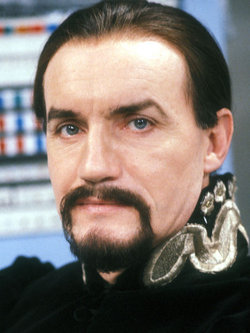
Continuity Cavalcade #1 - The Master's Timeline
Stories can get complicated, but we're used to complicated here at the A-List. Welcome to the first episode of Continuity Cavalcade, a brand-new show all about examining what continuity is and how it works, as well as the particular idiosyncrasies of individual stories. Look forward to episodes on Star Wars, Star Trek, DC and Marvel Comics, and many more! In our first episode, we'll be untangling the timeline of the Master from Doctor Who!
Image Source: Findagrave
Wednesday, February 13, 2019
Devil Doll (1964), by Lindsey Shonteff
There may have been a few of you last week who read my review for The Devil-Doll and thought to yourselves--"Hmm, that doesn't sound like the movie I watched on Mystery Science Theater 3000." Wrong Devil Doll! This is, like a few other inhabitants of the A-List, one of the movies that Joel/Mike/Jonah and the Bots introduced me to. This indie British chiller is nothing special, but it has enough trashy weirdness that it makes for a pretty entertaining watch even outside the riffs of the Satellite of Love.
The Great Vorelli is a stage hypnotist who works with a ventriloquist dummy named Hugo. There are many early intimations that Vorelli's shows are more than a little upsetting. First, he hypnotizes a dude into mentally taking the place of a Chinese person who the man saw executed. The trauma isn't permanent--the man forgets everything once Vorelli snaps his fingers--but it's hard to imagine any audience that would want to watch something like this. Then, when Hugo comes out, he and Vorelli prove to have a mutually abusive relationship. Admittedly, the audience still applauds wildly in the wake of his "comedy" routine that's about as funny as a math test. What is truly impressive about Vorelli's act is that he can ventriloquize (sure, we'll call it that) through Hugo without even having to touch him. It's like the doll is really alive.
But our story doesn't truly begin until Vorelli has met Marianne Horne, a wealthy girl who he hypnotizes into an expert dancer. It's clear that Vorelli has some sort of perverse lust for her, and when we meet Vorelli's other assistant, a 30ish woman who only covers half her ass onstage, we start to understand what sort of man Vorelli really is. It's clear that his current assistant has been drained of all hope and life by Vorelli's cruelty, and Marianne is about to be put on the same path. Marianne is scared of Vorelli--she says that much to her reporter boyfriend, an American named Mark English (an American named English...was that someone's idea of a joke?). But he telepathically compels her to come visit him, so she can invite him to her aunt's charity ball. During this time he shows as a wine called "Blood of the Virgin," and he begins to hypnotize her he repeats that the wine is "deep...rich...red...warm..." Ughhh. Nothing happens yet, but after a once-again depressing excuse for a show at the charity ball, where Hugo actually threatens Vorelli with a knife, Vorelli drags Marianne further under his spell and rapes her. Hugo, whatever he is, has had enough. He goes to find Mark, and tells him to look up what he was doing in 1948 Berlin. Mark sends a reporter friend to Berlin to investigate. Meanwhile, Vorelli ends up in some rather confusing soup when Hugo kills his washed-up cheeky assistant, to frame him for murder. Not only is this point basically forgotten, but it paints Hugo, a sympathetic character, as a murderer. It contributes to a surreal noir-like griminess that haunts the movie even outside of Vorelli's shows.
It becomes clear that Hugo was not always a dummy--in the late '40s, in Germany, he was Vorelli's assistant, after the man spent a prolonged period of time studying both medicine and mystical techniques in soul-transference. Eventually, during a show, Vorelli killed Hugo in a way that trapped his soul in the dummy. Now Vorelli intends to do the same to Marianne, apparently so he can get her family's money. What?! I would assume he would want his "bride-to-be" to keep her human body for as long as possible, given what he's done to it so far--and what he has a habit of doing to his female assistants. For a movie with this much sexual grime oozing up from beneath, it's a little jarring for the film to claim that the primary interest of this villain is money.
But anyway, this is all leading up to one of the best fight scenes of all time, pitting man vs. dummy. I can't possibly describe how ludicrously awful this fight is, so I will encourage you only to seek the film out for yourselves. It's a sight to see.
Devil Doll is an ever-welcome combination of cheap sleaze and effective atmosphere. Vorelli's show at the beginning is murky, smoky, and sweaty--there is no music, save for the ominous thumping beat we the audience get to hear. It would be an astonishingly eerie experience to watch a man force another man to believe he's going to be shot in the head in silence, in the dark. This movie seems like the sort of thing that would be decently shocking in early-'60s Britain, if anyone actually saw it. Plus, Hugo is a scary motherfucker--when Vorelli calls him ugly, he unfortunately does have something of a point. I'm not saying that this is horror gold, but the mixture of the sleaze with the oily, claustrophobic atmosphere is interesting to watch. Especially when it all falls out and becomes funny again. Invite Tod Browning over and you'll have yourself a zany double feature.
Oh, and I'll quote it before you know it: "Ham! I love it."
You can follow us on Facebook to get updates, and support the site by helping out on Patreon!
Labels:
atmospheric,
British,
dolls,
horror,
mystery,
possession,
puppets,
rape TW,
sex,
soul transfer
Wednesday, February 6, 2019
The Devil-Doll (1936), by Tod Browning
And we're back!
We are switching back to written reviews for 2019, but rest assured there will still be plenty of podcast action at the A-List with a new show, Continuity Cavalcade, where we'll be examining oddities of canon and continuity across a lot of different shows and movies. You'll get to listen to that later this month. For now, however, let's get back on familiarly loopy ground with a return to the world of Tod Browning.
Paul Levond (Lionel Barrymore) is a convict who has been running from prison for weeks in the company of his cellmate Marcel. (Before we go any further, yes, Lionel Barrymore is playing a Frenchman, and no, he does not attempt any sort of accent besides his own.) Levond has been sitting in stir for 17 years now after his cheating bank partners embezzled their institution and framed him for it. While Marcel notes that Levond's heart is full of hate, he insists that he has something worthy to contribute to mankind. The two limp through the feverish swamps to his hidden laboratory, maintained by his disabled wife Malita, who sports a skunk-stripe in her hair and happens to be a mistress of goofy mad-science faces. It turns out she and Marcel had been working on a strange experiment that involves shrinking people's atoms so they become doll-like. Smaller people require less food, and so why not shrink people until there's enough to go around? Certainly beats snapping your fingers to kill half the universe. What's interesting is that the shrinkage's effect on the brain causes them to become even more doll-like, in that they can't move. Can't move, that is, until they are animated by an outside will. Yep--Marcel and his wife have created shrunken telepathy-controlled zombies. That's a pretty convenient thing to have control over when your cellmate dies, and your primary goal in life involves covertly assassinating the jackals who screwed you over. What I'm saying is that Levond and Malita are moving to Paris, where the latter will continue her experiments for the benefit of the former, while giving him a secret weapon to use against the three crooked bankers.
And man oh man do Levond and his newfound assistant show up in style. When we finally see Levond in Paris it's after he's established himself as an elderly, kindly toy shop owner named Madame Mandelip. Yes, it's Lionel Barrymore in drag. This strange angle is an attempt to connect it to the A. Merritt story this is based on, Burn, Witch, Burn, which otherwise has nothing to do with superscientific doll people or even a man escaping from prison and hiding in drag. In the original story, however, there is a menacing old woman, and in order to adapt that part of the tale Browning had to have his criminal lead disguise himself as an aging widow. In any case, Madame Mandelip's toy business is a perfect cover to get the killer "dolls" into the millionaire's houses. Indeed, it's so easy that the movie needs another plot to keep itself as a respectable runtime. Levond also wants to make good for his daughter Lorraine, who hatefully believes him to be a criminal and is trapped in an awful laundry where she earns next to nothing. He is deeply hurt that she hates him so much, and this helps guide him into extracting a confession from the last surviving banker which exonerates his family. He visits her and her grandmother as Madame Mandelip, where we learn the specifics on how deep Lorraine's disgust of her father goes. After obtaining redemption, Levond has one last meeting with his daughter, where he tries to offer her closure. Posing as Marcel, he tells her that her father is dead, but that he loved her very much, and wants her to forget him so she can be happy with her taxi-driver boyfriend. Levond then leaves the Eiffel Tower to step out into an unknown fate.
Tod Browning loved sentimentalism when he wasn't being crass. Much of the emotion is overdone, especially with Barrymore chewing every bit of scenery he can get his jaws around--though nothing quite makes it to Mark of the Vampire's "He used it to--to cup the blood." In any case, the theme here is nakedly meant to be one of love vs. hate. Characters talk about the hate Levond holds in his heart, Lorraine talks about how much she hates her father, and both of them turn out to be wrong. By giving in to their love for each other, they share one last beautiful moment as father and daughter, even though the latter isn't aware of that the man speaking to her is her father. It's compassion rather than pure vengeance or disgust that fixes things. Hey, I'll take it. I love love.
But then you remember that this is welded onto a movie about shrunken people who can be telepathically controlled. And how we're supposed to buy that toy horses and dogs are acceptable stand-ins for such. When the matte effects do show up, they're startlingly effective for the time, but are still a little Bert I. Gordon-ish. What makes the mad science great is Malita. It is clear by film's end that she is totally unhinged, even if her madness is linked to a beneficial goal. Admittedly, however, Levond has a point when he calls her work "monstrous." How much would you want to be shrunken down, in the interest of saving resources? Especially if the process was notably flawed? Good mad science is something helpful gone wrong--because who would genuinely go out of their way to make monsters? I love Malita's character and she helps make everything work.
The skunk-stripe in her hair, though, points out something interesting, which I only just noticed on this watch-through: this movie is totally ripping off the previous year's Bride of Frankenstein. Malita resembles the bride herself. At one point, she makes the shrunken people dance for her, just like Pretorious' dancing homunculi. And part of the climax even involves someone yelling something about "blowing yourself to atoms"! The ripoff is frankly kind of obvious now that I think about it, and I really can't help but wonder if this was meant as Browning's middle finger to Universal. "You want to make a crazy-ass mad science movie that makes you a ton of money? Fine, I'll just go on to the same thing for MGM!" Of course, it could have been a studio mandate, too. But I want to give Browning some credit.
Sakes. This was nuts. But it's so good to be back.
You can follow us on Facebook to get updates, and help keep the site running by helping out on Patreon!
Labels:
crime,
criminals,
dolls,
drag,
horror,
insanity,
mad science,
sci-fi,
surreal,
vigilantes,
zombies
Subscribe to:
Posts (Atom)